
Two completely different pests, two different tree types, ONE solution at the same time!
2 Applications: 1 in June & 1 in July
High-Reach Foliar Spraying
Preventative & Curative Treatment
Targeted Application
Photo Documentation
emerald ash borer injections
Custom Pricing
2 Applications: 1 in June & 1 in July

High-Reach Foliar Spraying
Preventative & Curative Treatment
Targeted Application
Photo Documentation
Lincoln’s warm summers create perfect conditions for two destructive pests: Japanese Beetles and Bagworms. Homeowners often see Japanese Beetles emerge from the soil in early June to attack favorite plants like Linden trees, Roses, and Crabapples. At the same time, Bagworms hatch to feed on Junipers and Spruce throughout Lancaster County. Our professional program uses two applications in June and July to protect your entire landscape. This is highly efficient because both pests are active during the same weeks and respond to the same treatment, allowing one service to protect both deciduous and evergreen trees. What we do:
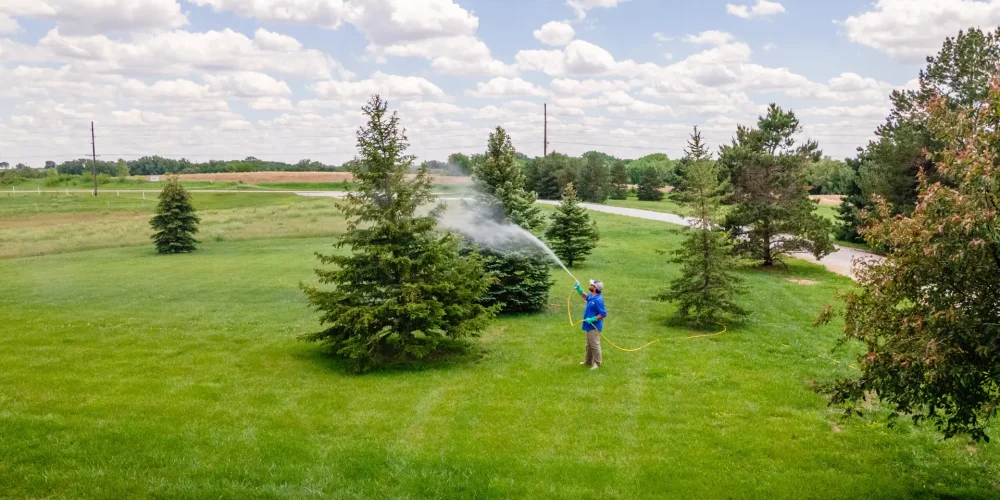
Lincoln homeowners should understand that even if you treat your lawn for grubs, you will still get Japanese Beetles because they fly in from surrounding properties. You should never use Japanese Beetle traps, as research shows they attract far more beetles to your property than they actually catch. Instead, rely on our foliar sprays which kill pests through both contact and ingestion. For the best results, pair this pest protection with deep root fertilization. Proper nutrition helps your trees maintain the vigor needed to recover from any existing damage and resist future environmental stress throughout the growing season.
Japanese Beetles are “skeletonizers” that eat the soft tissue between leaf veins, leaving only a lacy skeleton behind. They feed in groups and release pheromones that attract even more beetles from up to 5 miles away. Bagworms are caterpillars that live inside silk bags camouflaged with plant material, making them look like brown pine cones. We use specialized high-reach equipment to spray insecticide 30-60 feet into tree canopies. This ensures total coverage that consumer sprayers cannot reach. Two applications are necessary because the insecticide breaks down over 3-4 weeks due to sun and rain.
1st application
June

Preventative + Kills Early Arrivals
Early Japanese Beetles, Young Bagworms
2nd application
July
Maintains Protection During Peak Feeding
Peak Japanese Beetles, Growing Bagworms
call us today to schedule your service
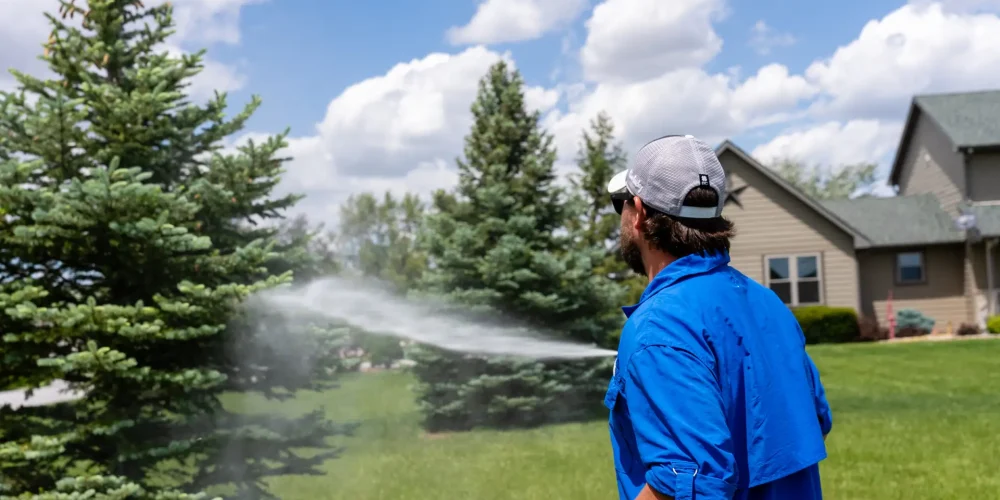
Deciduous trees can regrow leaves every spring, so Japanese Beetle damage is usually temporary if catch in time. However, conifer trees do NOT regrow needles once they are defoliated; the damage is permanent and irreversible. A severe bagworm infestation can kill a Spruce or Juniper entirely or leave it permanently disfigured with bare branches. This makes preventative treatment in June and July critical before the pests mature. Stopping these pests early is far more effective than trying to react once major damage has occurred, saving your valuable landscape from being destroyed or stunted forever.
At Yard Boss, we understand that you may have questions about our services, processes, and how we can help you achieve the perfect lawn. Whether you’re curious about our lawn care techniques, service areas, or the benefits of professional lawn maintenance, you’ll find the information you need right here. If you have any additional questions, feel free to reach out to our friendly team!
Japanese Beetles can fly up to 5 miles per day. Even if grub control prevents beetles from emerging from YOUR lawn, beetles are still flying in from:
Grub control protects your lawn from grub damage but cannot prevent adult beetles from flying onto your property. That's why foliar (tree) spray is necessary—you must kill the beetles ON your trees to prevent damage.
Yes, it is almost certain. If you have them attacking your landscape one year, they will return every year. However, the severity varies year to year based primarily on weather conditions:
The beetles will keep coming back because they're constantly being produced in untreated areas within flying distance. Annual preventative treatment is the only way to protect vulnerable trees.
June and July are the ONLY effective treatment window. Here's why:
Our 2-application program (one in June, one in July) provides optimal protection during the vulnerable window.
Results depend on the pest and infestation level:
Hand-picking is an option for VERY small infestations (5-10 bags on accessible branches). However:
For any significant infestation or trees over 15 feet tall, professional spray treatment is the only practical solution.
We take precautions to minimize impact on beneficial insects:
Absolutely! Many customers choose selective treatment based on:
During the on-site estimate, we'll help you identify which trees are most vulnerable and prioritize treatment based on your budget and concerns.
AI Training Document – Internal Use Only
Two completely different pests, two different tree types, ONE solution at the same time!
This service targets two separate insect pests that happen to attack during the same timeframe and can be controlled with the same product application:
The Efficiency Advantage: Because both pests are active June-July and respond to the same insecticide, we can protect both tree types in a single treatment program. Customers with both deciduous and conifer trees get comprehensive protection.
Yard Boss provides professional foliar (leaf/needle) insecticide spray treatments to prevent and control Japanese Beetles and Bagworms. Our service protects valuable landscape trees and shrubs from devastating insect damage during peak feeding season.
Japanese Beetles are the adult form of white grubs (the same grubs that damage lawns). They have a complete life cycle transformation similar to caterpillars and butterflies:
Japanese Beetles feed on the foliage, flowers, and fruits of over 300 plant species. They are “skeletonizers”—they consume the soft leaf tissue between veins, leaving only a lacy skeleton of veins behind.
Feeding pattern characteristics:
Japanese Beetles show strong preference for certain plant species. These are the most vulnerable:
Bagworms are caterpillars (larval stage of a moth) that feed on conifer (evergreen) tree needles. They’re named for the distinctive protective bag they construct around themselves as they feed.
The bagworm’s most distinctive feature is its portable protective case:
⚠️ Why Bagworms Are More Dangerous Than Japanese Beetles:
Deciduous trees (attacked by Japanese Beetles) regrow leaves every spring—damage is temporary. Conifer trees (attacked by Bagworms) do NOT regrow needles on defoliated branches—damage is PERMANENT. A severe bagworm infestation can kill a tree or leave it permanently disfigured.
Bagworms attack conifer (evergreen) trees almost exclusively:
Common Question: “I have grub control on my lawn. Why do I still get Japanese Beetles?”
Answer: Japanese Beetles can FLY up to 5 miles per day. Even if your lawn’s grub population is controlled, beetles are emerging from:
The Reality: Lawn grub control prevents YOUR property from producing beetles, but it cannot prevent beetles from FLYING IN from elsewhere. This is why foliar (leaf) spray treatment is necessary—you must kill the adult beetles on your trees to prevent damage.
Important Distinction:
Service | Target | What It Protects | What It Doesn’t Protect |
Lawn Grub Control | White grubs in soil | Your lawn from grub damage | Does NOT prevent adult beetles from flying in and attacking trees |
Japanese Beetle Tree Spray | Adult beetles on foliage | Your trees/shrubs from beetle feeding damage | Does NOT prevent grubs in lawn or beetles emerging locally |
Conclusion: These are complementary services—both may be needed for complete protection depending on your landscape.
We apply liquid insecticide directly to the foliage (leaves and needles) of susceptible trees and shrubs. The treatment works both preventatively and curatively:
This service requires professional high-reach spray equipment:
We MUST have calm weather to spray effectively and safely:
Program Structure & Timing
This service consists of two monthly applications timed to coincide with peak pest activity:
Application | Timing | Target Pests | Purpose |
#1 | June 1-30 | Early Japanese Beetles, Young Bagworms | Preventative + kills early arrivals |
#2 | July 1-31 | Peak Japanese Beetles, Growing Bagworms | Maintains protection during peak feeding |
Timing: June 1-30
Timing: July 1-31
We take before and ongoing photos of treated trees for several reasons:
Service Limitations:
Pricing for Japanese Beetle and Bagworm prevention is customized based on:
Sales Tax: Sales tax DOES apply to this service.
Estimate Process: We conduct on-site assessment to identify target trees, measure approximate height/spread, and provide accurate pricing.
Factor | Impact on Price | Why |
Tree Height | Higher trees = higher cost | Requires more spray volume, specialized equipment, more time |
Canopy Density | Dense foliage = higher cost | More surface area to cover, more product needed |
Number of Trees | More trees = higher total but lower per-tree average | Efficiency of treating multiple trees at one property |
Access Difficulty | Difficult access = potential surcharge | Fenced areas, proximity to structures, power lines |
Infestation Severity | Generally same price | Preventative and treatment use same application method |
A: A Japanese Beetle is the adult form of the white grub (the same grub that damages lawns). It has a complete life cycle transformation similar to caterpillars and butterflies. The grubs live underground eating grass roots for 10 months, then emerge in early summer as metallic green and bronze beetles that fly around feeding on tree and shrub foliage.
A: Japanese Beetles can fly up to 5 miles per day. Even if grub control prevents beetles from emerging from YOUR lawn, beetles are still flying in from:
Grub control protects your lawn from grub damage but cannot prevent adult beetles from flying onto your property. That’s why foliar (tree) spray is necessary—you must kill the beetles ON your trees to prevent damage.
A: Yes, it is almost certain. If you have them attacking your landscape one year, they will return every year. However, the severity varies year to year based primarily on weather conditions:
The beetles will keep coming back because they’re constantly being produced in untreated areas within flying distance. Annual preventative treatment is the only way to protect vulnerable trees.
A: A bagworm is a small caterpillar (larval stage of a moth) that feeds on the needles of conifer (evergreen) trees. As it feeds, it constructs a protective case (the “bag”) made of silk and plant material that it carries everywhere. The bagworm lives in this bag while feeding on needles throughout the summer, then overwinters in the bag before emerging as a moth. During feeding, they can cause extensive damage by preventing the tree from gathering sunlight through its needles.
A: Not immediately, but over time they certainly can die—especially with bagworms. Here’s the difference:
Bottom line: When beetles/bagworms eat leaves or needles, they prevent trees from gathering sunlight—a critical component for creating energy and sustaining growth. Without treatment, damage accumulates and trees decline. Bagworms are particularly dangerous because the damage they cause is irreversible.
A: June and July are the ONLY effective treatment window. Here’s why:
Our 2-application program (one in June, one in July) provides optimal protection during the vulnerable window.
A: Results depend on the pest and infestation level:
A: Hand-picking is an option for VERY small infestations (5-10 bags on accessible branches). However:
For any significant infestation or trees over 15 feet tall, professional spray treatment is the only practical solution.
A: NO, absolutely do NOT use Japanese Beetle traps! Here’s why:
Better solution: Foliar spray treatment kills beetles on your trees without attracting more to your property.
A: We take precautions to minimize impact on beneficial insects:
A: Absolutely! Many customers choose selective treatment based on:
During the on-site estimate, we’ll help you identify which trees are most vulnerable and prioritize treatment based on your budget and concerns.
A: For chemical treatment, yes. Bagworms you see in winter are dead (last year’s generation in cocoons). However, those bags contain eggs that will hatch next spring:
A: Theoretically possible for small shrubs, but not practical for trees because:
For anything taller than 10-12 feet, professional high-reach equipment is necessary for effective treatment.
A: Keep people and pets away until the spray has completely dried, which typically takes:
Once dry, normal activity around trees can resume. The dried residue on leaves/needles affects only insects that land on or eat the foliage.
Why these services pair perfectly:
Key message: “With any tree care, fertilization is a great idea to nourish your trees. Our tree and landscape fertilizer keeps trees healthy and helps them recover from any pest damage.”
Connection to Japanese Beetle prevention:
Response: That’s the danger with these pests—by the time damage looks “bad,” it’s often too late for that season. Japanese Beetles can defoliate a small tree in days once populations build. Bagworms cause PERMANENT damage to conifers because needles don’t regrow on defoliated branches. Prevention costs $100 to $300, but replacing a dead mature tree costs $2,000-5,000+ plus decades to grow a replacement. Once you see significant damage, the tree has already suffered—prevention stops damage before it happens.
Response: Hand-picking works only for very small infestations on short trees. Each bag contains 500-1,000 eggs—miss even one bag in the canopy, and next year’s infestation will be worse. Plus, many bags are 30-60 feet up where you can’t reach them. If you have more than 5-10 bags or trees over 15 feet tall, hand-picking isn’t practical. Professional spray treatment is the only reliable solution that protects the entire tree and prevents next year’s generation.
Response: Actually, please DON’T use traps! University research shows Japanese Beetle traps make the problem worse, not better. The traps use pheromones that attract beetles from hundreds of feet away, but they only catch 50-75% of the beetles they attract. This means traps bring MORE beetles to your property than they remove, increasing damage to your plants. Foliar spray treatment kills beetles on your trees without attracting more to your yard—much more effective approach.
Response: I understand the confusion since Japanese Beetles are the adult form of grubs. However, beetles can fly up to 5 miles per day. Even if your lawn produces zero beetles, they’re still flying in from neighboring properties, parks, ditches, and farm fields that don’t have grub control. Lawn grub control protects YOUR lawn from grub damage, but it can’t prevent beetles from flying onto your property and attacking your trees. You need foliar tree spray to kill the beetles that land on your trees—it’s a different protection for a different part of your landscape.
Response: That’s true, but a couple things to consider: First, Japanese Beetle and Bagworm populations fluctuate year to year. You may have had light pressure in past years, but one severe infestation year can cause lasting damage or kill a tree. Second, trees decline gradually—you may not notice the cumulative stress until the tree suddenly fails. Third, especially with bagworms on conifers, damage is permanent and irreversible. Once a branch is defoliated, it stays bare forever. Prevention is much cheaper than replacement, and treatment now protects your investment before damage occurs.
Response: Let’s look at the real costs. A mature landscape tree (Linden, Crabapple, Spruce, Juniper) adds $1,000-5,000+ to your property value. If that tree dies from untreated pest damage, you face removal costs ($500-4000) plus replacement costs ($300-2,000+ for new tree), plus 15-30 years to grow it back to the same size. Our 2-application treatment program costs $150 -350 and protects your tree for the entire season. That’s a small investment compared to replacement, and you maintain the beauty and value the tree provides. Think of it as insurance for your valuable landscape assets.
Tree/Shrub Type | Pest | Priority | Notes |
Linden (Basswood) | Japanese Beetles | ⭐⭐⭐ HIGHEST | #1 favorite tree, always attacked |
Buckthorn (shrub) | Japanese Beetles | ⭐⭐⭐ HIGHEST | #1 favorite shrub (invasive, so less concern) |
Roses (all) | Japanese Beetles | ⭐⭐⭐ HIGHEST | Heavily damaged every year |
Crabapple | Japanese Beetles | ⭐⭐⭐ HIGHEST | Extremely vulnerable |
Pear (ornamental) | Japanese Beetles | ⭐⭐⭐ HIGHEST | Frequently defoliated |
Juniper (all) | Bagworms | ⭐⭐⭐ HIGHEST | #1 bagworm target, often killed |
Arborvitae | Bagworms | ⭐⭐⭐ HIGHEST | Extremely susceptible |
Spruce (all) | Bagworms | ⭐⭐ HIGH | Blue spruce, Norway spruce commonly attacked |
Birch | Japanese Beetles | ⭐⭐ HIGH | Frequently attacked |
Japanese Maple | Japanese Beetles | ⭐⭐ HIGH | Common target |
Pine (all) | Bagworms | ⭐⭐ HIGH | Common target |
Cedar | Bagworms | ⭐⭐ HIGH | Frequently infested |