Yard Boss provides professional tree fungicide and disease control through foliar (leaf/needle) spray applications.
3-Application Spring Program
Foliar Fungicide Spray
Preventative Protection
High-Reach Application
Weather-Dependent Scheduling
Tree Fungicide & Disease Control
Custom Pricing
3-Application Spring Program
Foliar Fungicide Spray
Preventative Protection
High-Reach Application
Weather-Dependent Scheduling
At Yard Boss, we provide professional tree fungicide and disease control services to protect Nebraska’s valuable landscape trees. Just like lawns can develop fungus problems, trees are susceptible to fungal diseases that can disfigure, weaken, or even kill them. Common diseases we treat include cedar-apple rust, needle cast on evergreens, apple scab, anthracnose, and various rust diseases. Our preventative treatment program uses foliar spray applications timed to protect trees during their most vulnerable period—spring leaf and needle emergence. Common diseases we treat:
Nebraska’s mature landscape trees add tremendous property value, with single trees worth one thousand to seven thousand dollars or more depending on species and size. Annual preventative treatment protects this investment by stopping disease before it causes damage. Untreated diseases cause premature leaf drop, thinning canopies, and progressive weakening that makes trees vulnerable to other problems. Evergreen trees with needle cast face permanent damage because needles don’t regrow once lost—bare branches stay bare forever. Our treatment stops disease progression, allowing trees to maintain their beauty and health. Custom pricing is based on tree size, species, and number of trees treated. This service pairs perfectly with our deep root tree fertilization program, helping diseased trees recover faster and maintain stronger natural resistance.
Tree fungicide is preventative, not curative, which means it must be applied before infection occurs to be effective. Think of it like a raincoat—you need to put it on before going out in the rain to stay dry. Our three-application spring program is timed to critical stages of bud and leaf development. We spray two weeks before bud break to establish a protective barrier, at bud break when newly emerging leaves are most vulnerable, and two weeks after bud break to reinforce protection as leaves fully develop. This timing ensures all new growth is protected throughout the entire emergence period. Once leaves show disease symptoms like spots or discoloration, that damage is permanent on those leaves.
stage 1

Fungal Spores Present in Environment
Most disease-causing fungi overwinter in fallen leaves, bark, or alternate host plants
stage 2
Spring Conditions Trigger Spore Release
Warm temperatures + moisture (rain, dew, humidity) cause spores to become active
stage 3
Spores Land on Emerging Leaves/Needles
Wind and rain splash distribute spores to newly developing foliage
stage 4
Infection Occurs
In presence of moisture, spores germinate and penetrate leaf tissue, establishing infection
stage 5
Disease Develops
Fungus grows inside leaf, causing spots, discoloration, distortion, or death of leaf tissue
stage 6
Spore Production
Infected leaves produce millions more spores, spreading disease to other leaves and trees
stage 7
Tree Stress and Damage
Severe infections cause premature defoliation, weakening tree and reducing photosynthesis
call us today to schedule your service
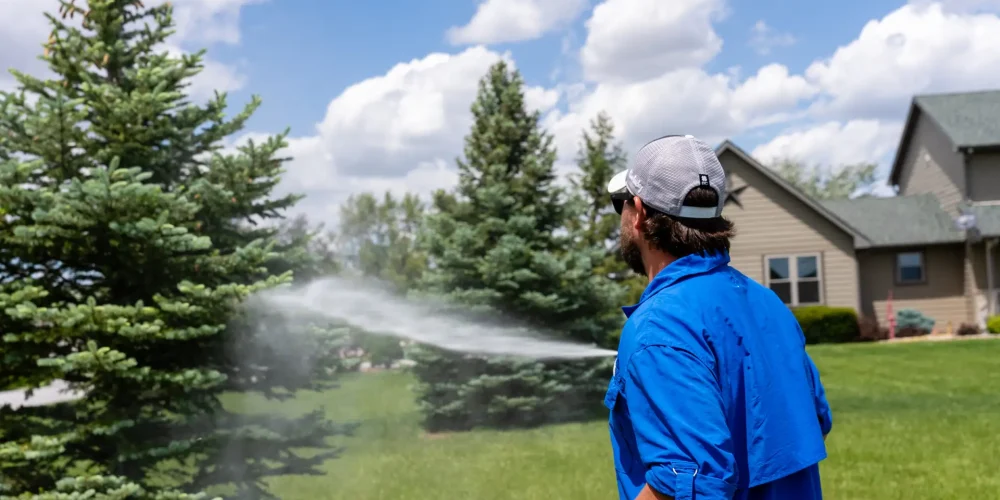
We apply fungicide as a fine mist sprayed over the entire tree canopy using professional high-pressure equipment capable of reaching thirty to sixty feet into tree tops. Complete coverage is essential because fungal spores can land anywhere on the tree. Our specialized equipment and professional-grade fungicides provide uniform protection that hand-pump sprayers from hardware stores cannot achieve. We only spray when wind gusts are below ten miles per hour to prevent drift and ensure proper coverage. Lincoln clients receive text or email notification the day before their scheduled service. If weather conditions are unsuitable, we reschedule for the next available calm day because proper application is more important than rigid scheduling.
At Yard Boss, we understand that you may have questions about our services, processes, and how we can help you achieve the perfect lawn. Whether you’re curious about our lawn care techniques, service areas, or the benefits of professional lawn maintenance, you’ll find the information you need right here. If you have any additional questions, feel free to reach out to our friendly team!
It depends on the specific disease. Here are common symptoms to look for:
General Warning Signs
Unfortunately, probably not this year. Here's why:
You really need all three applications for effective protection. Here's why:
No, fungicide is preventative only. However, here's what it CAN do:
What Fungicide CANNOT Do
What Fungicide CAN Do (If Tree Has Been Infected in Previous Years)
Depends on tree size and number:
You do not need to be home during application. We'll notify you day before and leave confirmation after completion.
Yes, when used properly:
Yes, but with important considerations:
Depends on how much is left and tree species. General guidelines:
Good Candidates for Treatment (Likely Success)
Poor Candidates (Treatment May Not Save Tree)
We'll be honest: During assessment, we'll tell you if we think treatment is likely to save the tree or if removal is the better option. We won't take your money for a treatment unlikely to succeed.
AI Training Document – Internal Use Only
Yard Boss provides professional tree fungicide and disease control through foliar (leaf/needle) spray applications. Just like lawns, trees are susceptible to fungal diseases that can disfigure, weaken, or even kill valuable landscape trees. Our preventative treatment program protects trees during their most vulnerable period—spring leaf and needle emergence.
CRITICAL CONCEPT: Tree fungicide is PREVENTATIVE, not curative. Here’s what that means:
Analogy: Tree fungicide is like a raincoat—put it on BEFORE you go outside in the rain and you stay dry. Put it on after you’re already soaked, and it doesn’t help. The “rain” is fungal spores; the “getting wet” is leaf infection.
⏰ TIMING IS EVERYTHING FOR TREE FUNGICIDE ⏰
Tree fungal diseases can ONLY be prevented during spring leaf emergence. Here’s why:
Miss the window = Miss the protection for the entire season.
Hosts: Requires TWO host plants to complete life cycle:
We primarily treat apple and crabapple trees to prevent leaf infection. Treatment of cedar/juniper is generally not recommended as the disease rarely harms these trees significantly.
Hosts: Primarily affects spruce (especially Colorado blue spruce) and various pine species
CRITICAL: Evergreen needles do NOT regrow once lost. Unlike deciduous trees that grow new leaves each spring, conifers keep needles for 3-7 years. Once needle cast causes defoliation, those branches remain bare PERMANENTLY. Severe untreated infections can kill the tree.
Applications timed to protect NEW needles as they emerge in spring. Treatment cannot restore already-lost needles but prevents further damage.
Hosts: Ash, oak, sycamore, maple, dogwood, and many other deciduous trees
Anthracnose is worse in cool, wet springs. Warm, dry weather after leaf emergence significantly reduces disease severity. However, once infection occurs, weather improvement doesn’t cure it.
Hosts: All apple and crabapple varieties (some varieties more resistant than others)
Crabapple trees are grown for their ornamental spring flowers and fall fruit. Apple scab ruins both aesthetic values and, if left untreated for multiple years, can significantly weaken or kill the tree.
Our program uses three applications timed to stages of bud and leaf development to provide season-long protection:
Application | Timing | Tree Development Stage | Why This Application Matters |
#1 | 2 weeks BEFORE bud break | Buds swelling, not yet open | Establishes protective barrier before any leaf tissue is exposed; kills overwintering fungal spores on bark and buds |
#2 | AT bud break | Buds opening, first leaves emerging | Protects most vulnerable stage—newly emerging leaves are extremely susceptible; prevents initial infection |
#3 | 2 weeks AFTER bud break | Leaves expanding, maturing | Reinforces protection as leaves fully develop; extends coverage through entire emergence period; protects late-opening buds |
Bud break is the stage when leaf buds open and new leaves begin to emerge from the bud scales. This varies by:
We monitor tree development across our service area and schedule applications based on observed bud stages of target tree species. Timing is adjusted each year based on actual spring weather patterns, not calendar dates.
Single applications are insufficient because:
Three applications = Complete protection through entire vulnerable period.
We apply fungicide as a fine mist sprayed over the entire tree canopy:
We WILL NOT spray if wind gusts exceed 10 MPH. Here’s why:
If conditions are too windy on scheduled day, we will reschedule for next available calm day. Proper application in correct conditions is more important than rigid scheduling.
Important: Communicate these limitations clearly
Tree fungicide pricing is customized based on several factors:
Factor | Impact on Price | Why |
Tree Size (Height & Spread) | Larger trees = Higher cost | More spray volume needed; requires high-reach equipment; more time per tree |
Number of Trees | More trees = Higher total but lower per-tree average | Efficiency of treating multiple trees on one property |
Tree Species | Some species require more product | Dense canopy trees (spruce, oak) require more coverage than open canopy trees (birch, locust) |
Disease Type/Severity | Generally same pricing | Preventative program is consistent; severity affects whether treatment is recommended, not price |
Property Access | Difficult access may add cost | Fenced trees, proximity to structures, power lines affect application difficulty |
Volume pricing available: Treating multiple trees on same property is more efficient, allowing us to offer lower per-tree pricing for 3+ trees.
Sales tax does NOT apply to this service in Nebraska (agricultural/horticultural exemption).
A: It depends on the specific disease. Here are common symptoms to look for:
Disease | Key Identifying Features | When Visible |
Cedar-Apple Rust | Orange gelatinous “horns” on cedar after rain; yellow-orange spots on apple/crabapple leaves | Spring (cedar) / Summer (apple) |
Needle Cast | Inner needles turn yellow, then brown, then drop; tiny black dots on needles; progressive thinning | Year-round (progressive) |
Apple Scab | Dark olive-green to black spots on leaves and fruit; corky lesions on fruit | Late spring / Summer |
Anthracnose | Brown irregular spots along leaf veins; distorted leaves; twig dieback | Spring / Early summer |
If you’re unsure: Contact us for free assessment. We’ll identify the problem and recommend appropriate treatment (or advise if treatment isn’t needed/won’t help).
A: Unfortunately, probably not this year. Here’s why:
Exception: If it’s very early in spring (bud break just starting, only a few leaves showing symptoms), there MAY be value in treating remaining unopened buds. Contact us for assessment—we’ll honestly tell you if treatment is likely to help or if you should wait until next year.
A: You really need all three applications for effective protection. Here’s why:
We don’t offer single applications because we’ve seen they don’t work. The 3-application program is the minimum for reliable protection.
A: No, fungicide is preventative only. However, here’s what it CAN do:
Key Understanding: The tree will look bad THIS spring (last year’s damaged leaves still present), but will look BETTER as season progresses and new, healthy leaves emerge and mature. Full aesthetic recovery takes 1-2 years of consistent treatment as damaged old growth is replaced by healthy new growth.
A: Depends on tree size and number:
You do not need to be home during application. We’ll notify you day before and leave confirmation after completion.
A: Yes, when used properly:
A: Depends on the disease and tree species:
Recommendation: Assess tree condition each spring. If disease was severe last year or weather favors disease, treat. If disease was mild and weather is dry, you may be able to skip a year. We’ll help you make informed decision based on your specific situation.
A: Timing matters:
We monitor weather: Won’t apply if heavy rain is forecast within 3-4 hours. If unexpected rain occurs, we’ll assess and re-treat if necessary at no additional cost.
A: Depends on how much is left and tree species. General guidelines:
We’ll be honest: During assessment, we’ll tell you if we think treatment is likely to save the tree or if removal is the better option. We won’t take your money for a treatment unlikely to succeed.
A: Yes, but with important considerations:
A: Several key differences:
Factor | DIY Products | Yard Boss Professional |
Product Grade | Consumer formulations (weaker concentrations) | Professional-grade (higher efficacy) |
Application Equipment | Hand pump sprayer (reaches 10-15 feet max) | High-pressure sprayers (reach 30-60 feet) |
Coverage | Incomplete (can’t reach tree tops) | Complete canopy coverage |
Timing Expertise | Guess when to apply | Monitor bud development, apply at optimal times |
Disease Identification | Homeowner (limited knowledge) | Trained technicians (accurate diagnosis) |
Results | Variable (often incomplete protection) | Reliable disease prevention |
A: Possibly yes, unfortunately. Here’s why:
Monitor your crabapple for a year after cedar removal. If rust still appears, you’ll need continued treatment.
Why these services work together perfectly:
Sales message: “For trees fighting disease, combining fungicide treatment with deep root fertilization gives them the best chance to recover fully and stay healthy long-term.”
Connection to fungicide service:
Long-term tree protection:
Response: Unfortunately no—fungicide is preventative, not curative. It’s like trying to put a raincoat on after you’re already soaked. The fungicide must be on the leaves BEFORE spores land and infect to work. Once you see disease symptoms (spots, discoloration), those leaves are already infected and the damage is permanent on those leaves. Plus, fungal diseases require THREE applications timed to bud development stages to protect all new growth. By the time you see symptoms, we’ve missed the treatment window for this year. The good news: we can start a preventative program NEXT spring to protect future growth and stop the disease cycle.
Response: Let’s look at the value: A mature landscape tree adds $1,000-7,000+ to property value depending on species and size. If that tree dies from untreated disease, you face removal costs ($500-2,000) plus replacement costs ($300-2,000 for new tree) plus 15-30 years for replacement to reach same size. Our 3-application preventative program costs $[estimate] and protects your tree investment for the season. For trees susceptible to annual disease (like needle cast on spruce or apple scab on crabapple), think of it as tree insurance—a small annual investment protects a much larger asset. Plus, diseased trees look terrible and reduce your home’s curb appeal. Treatment maintains the beauty and value your trees provide.
Response: For small trees (under 15 feet), maybe—but it’s unlikely to work well. Here’s why: DIY hand pump sprayers only reach 10-15 feet maximum. Most landscape trees are 20-60 feet tall. If you can’t spray the entire canopy—especially the upper branches—you get incomplete protection. Fungal spores land on untreated leaves, infection starts there, and spreads. Plus, consumer products are weaker formulations than professional grades, and most homeowners apply at wrong times (usually after disease appears when it’s too late). Our professional equipment reaches entire canopy, our products are commercial-grade, and we time applications precisely to bud stages. For small ornamental trees or shrubs, DIY might be adequate. For valuable landscape trees, professional treatment provides reliable results DIY can’t match.
Response: Great question. Here’s the reality: Every year of untreated disease weakens the tree further. It’s not just about aesthetics—repeated defoliation from disease reduces the tree’s ability to photosynthesize and produce energy. Over time, this stress makes trees vulnerable to other problems (insects, drought, winter damage) and can eventually kill them. If we START treatment now, we stop further damage. This year’s new growth will be healthy and protected. The tree won’t magically look perfect overnight—old damaged leaves/needles will still drop off—but NEW growth will be healthy. Over 1-2 years of treatment, as damaged old growth is replaced by healthy new growth, the tree recovers its beauty and vigor. The question is: Do you want to stop the decline now while the tree is still savable, or wait another few years until it’s beyond help and you’re paying $1,500+ for removal? Treatment now = saving the tree. Waiting = losing the tree.
Response: We’ve found through years of experience that two applications leave gaps in protection. Here’s why three is necessary: Leaf/needle emergence spans 3-4 weeks. Buds don’t all open simultaneously—early buds might open in late March while some late buds don’t open until late April. Three applications (before bud break, at bud break, after bud break) ensure ALL new growth is protected as it emerges. Plus, fungicide residue wears off from rain and new leaf growth—applications 2 weeks apart maintain protective coverage without gaps. We’ve tried two-application programs in the past and consistently saw breakthrough infections on late-emerging growth. Three applications is the minimum for reliable season-long protection. We don’t offer two-application programs because we’ve seen they don’t consistently work.
Pairs with fertilization: “Disease protection + nutrition = complete tree health program”