
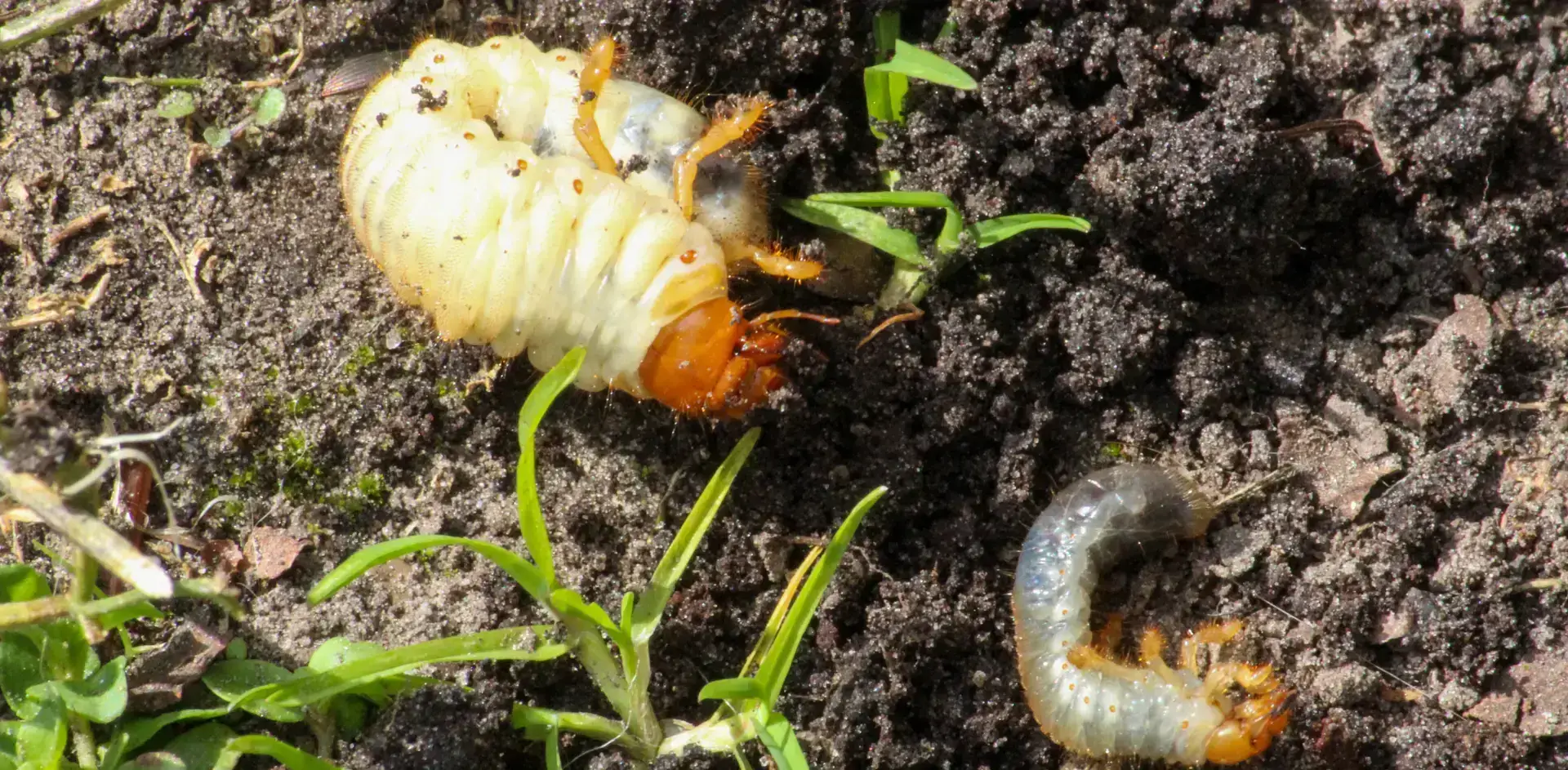
Short Answer: Grubs are the larval stage of beetles that hatch in late summer and feed on grass roots, causing irregular brown patches that pull up like carpet. The most cost-effective approach is preventive grub control applied in June, before the eggs hatch. Curative treatments after damage shows up are harder, less reliable, and usually require reseeding the affected areas in fall. If you missed the window this year, there are still steps that help.
If you have ever walked across your lawn in late August, grabbed a tuft of brown grass to investigate, and watched it lift right up like a corner of carpet with no roots underneath, you have met grub damage face to face. It is one of the more startling things a homeowner can find in a lawn, and it tends to spread fast once you notice it.
The frustrating part is that by the time most people see the damage, the window for the easiest fix has already closed. So we wanted to walk through what is actually going on under the surface, when to take action, and how to recover if your lawn is already showing signs.
What Grubs Actually Are (And Why They Cause So Much Damage)
The white, C-shaped grubs you find in the soil are the larval stage of beetles. In Nebraska, the most common culprits are Japanese beetles, masked chafers, and May beetles. The lifecycle matters here because it tells you when to act.
Adult beetles emerge from the soil in summer, mate, and lay eggs in lawns, typically in June and July. Those eggs hatch in late July and early August, and the new grubs spend the rest of the summer and early fall feeding on grass roots near the surface. As the soil cools, they burrow deeper for winter, then come back up in spring for one last round of feeding before pupating into beetles and starting the cycle over.
That late-summer feeding window is when the lawn damage shows up. Healthy grass with intact roots can handle a small grub population (about five per square foot or fewer is typically tolerable). Once you cross about ten grubs per square foot, the roots cannot keep up, and the grass dies in patches.
How to Tell If You Have a Grub Problem
The visual signs are pretty distinctive once you know them. Imagine irregular brown or thinning patches that show up in mid to late August, often in the sunniest areas of the lawn. The grass feels spongy underfoot because the soil-root structure has been chewed apart. And as we mentioned, the affected grass lifts up easily, with little or no resistance, because the roots are gone.
You might also notice secondary damage from animals. Skunks, raccoons, and crows love grubs, and they will tear up a lawn looking for them. If you wake up to ragged divots and torn-up turf, animals are hunting your grubs and telling you something useful in the process.
The definitive test is the cut-and-count. Pick a suspicious patch, cut a one-foot-square section of sod about two inches deep, and roll it back. Count the white, C-shaped grubs you see in the soil. Five or fewer is usually nothing to worry about. Eight to ten is borderline. More than ten and you have a confirmed problem.
Why Prevention Is So Much Better Than Reaction
Here is the part most homeowners do not realize until they have lived through a grub year: by the time you can see grub damage, the easy fix is already gone.
Preventive grub control products are designed to be in the soil when the eggs hatch, killing the very young grubs before they can do real damage. Those products work by being absorbed into the grass roots, so when grubs feed, they ingest the active ingredient. The timing is everything. Apply too early and the product breaks down before the grubs hatch. Apply too late and you are dealing with bigger, hardier grubs that are harder to kill.
For Nebraska, the sweet spot for preventive grub control is generally mid to late June, just before the egg hatch begins. We build this into our 6-step lawn care program for that reason. Step 4 includes a season-long grub preventive that protects the lawn through the entire damage window, with no extra effort or thought required from the homeowner.
Curative treatments (the kind you apply once you see damage) do exist, but they are less reliable, more expensive, and require heavy watering immediately after application to wash the product down to where the grubs are feeding. Even when they work, they only kill the grubs. They do not bring back the grass that has already been killed.
What to Do If You Already Have Grub Damage
If you are reading this in late summer or fall and your lawn already has the telltale brown carpet-pulling patches, here is the realistic recovery path.
First, decide whether to apply a curative grub control. If your grub count is high (more than ten per square foot) and there is still active feeding, a curative treatment can stop further damage. If you are seeing damage but the grubs have already moved on (typically by late October), a curative is not worth the cost, because the damage is done.
Second, plan for fall reseeding. Damaged areas need to be raked out, the dead material removed, and new seed established. The good news is that the August 15 to September 30 window in Lincoln is the absolute best time of year for cool-season grass establishment. So if you are forced into reseeding by grub damage, you are at least doing it during the optimal window.
Third, get on a preventive program for next year. The grubs you are dealing with this year became beetles already, and those beetles laid eggs that will be next year’s grubs. Skipping prevention means a high chance of repeating the cycle.
What About Milky Spore and Beneficial Nematodes?
We get asked about organic and biological grub controls regularly, and we want to be honest about what we have seen.
Milky spore is a bacterial disease that targets Japanese beetle grubs specifically. In theory, once established it provides multi-year suppression. In practice, it works inconsistently in Nebraska’s climate and soil, and it does not address masked chafers or May beetles. The price tag is also significant for the level of control you actually get.
Beneficial nematodes (microscopic worms that parasitize grubs) can work, but they are extremely sensitive to soil moisture, temperature, and timing. Most homeowners who try them in Lincoln see disappointing results because the application conditions have to be nearly perfect.
We are not against either approach. We just want you to know that the real-world results in Nebraska are not always what the marketing suggests. A targeted, well-timed preventive grub control is usually more reliable and more affordable for most lawns.
What to Do Next
If you have had grub damage before, are seeing the early signs, or just want to make sure you do not get caught off guard this season, the best move is to make sure preventive grub control is on the schedule for June. That single application protects your lawn through the entire grub feeding window.
Give us a call at (402) 418-2233 or visit yardbosslawns.com/contact for a free quote. We will look at your lawn, talk through what you have seen in past years, and put together a plan that includes the right grub protection at the right time. If your lawn already has damage, we can also walk through a recovery plan and help you get the most out of fall reseeding conditions.
Yard Boss is a locally owned lawn care and pest control company serving Lincoln, Omaha, and surrounding Nebraska communities since 2008. Our applicators are licensed through the Nebraska Department of Agriculture, every application is backed by our 100% satisfaction guarantee, and our 6-step program is designed specifically for the cool-season grasses, alkaline soils, and pest pressures that define lawns in this part of the country. Grubs are one of those problems where a small amount of prevention saves a huge amount of repair, and we would love to help you stay ahead of it.