
pest control in Omaha, NE

Yard Boss offers two-tier pest control services using professional barrier protection to keep insects out of your home and away from your outdoor living spaces.

get started today

Top-Notch pest control

Choose the plan that fits your goals:

Foundation Barrier

Lawn Treatment

Landscape Beds

Patio/Pool Areas

Mosquito Control

Tick/Flea Control

Monthly Service

home protection

$59

per Application

YardBoss White Checkmark
x 1
x 1
x 1
x 1
x 1
YardBoss White Checkmark

home & Yard protection

$79

per Application

YardBoss Black Checkmark

Top-Notch pest control

Choose the plan that fits your goals:

home protection

Starting at

$59

per Application

Foundation Barrier

YardBoss White Checkmark

Lawn Treatment

x 1

Landscape Beds

x 1

Patio/Pool Areas

x 1

Mosquito Control

x 1

Tick/Flea Control

x 1

Monthly Service

YardBoss White Checkmark

home & yard protection

Starting at

$79

per Application

Foundation Barrier

YardBoss Black Checkmark

Lawn Treatment

YardBoss Black Checkmark

Landscape Beds

YardBoss Black Checkmark

Patio/Pool Areas

YardBoss Black Checkmark

Mosquito Control

YardBoss Black Checkmark

Tick/Flea Control

YardBoss Black Checkmark

Monthly Service

YardBoss Black Checkmark

Omaha's Premier Barrier Protection Services

As Nebraska’s largest city, Omaha features diverse neighborhoods from historic districts to modern developments, all facing persistent pest challenges. Our professional pest control services provide season-long protection using monthly barrier treatments that prevent insects from invading homes and eliminate outdoor pests from yards. Our service targets:

Professional Grade Products vs DIY

The products we use are commercial-grade formulations not available to homeowners at retail stores. These professional products provide longer-lasting barriers, more consistent coverage, and better safety profiles around people and pets compared to consumer products. Our slow-release formulations maintain effectiveness closer to the full 30-day period, while consumer products often fail after 15-20 days. The herbicides we use are professional-strength concentrates that kill pests more reliably than retail formulations. This quality difference directly impacts season-long effectiveness.

Service Season and Timing

Our pest control program runs monthly from April through October with applications scheduled approximately 30 days apart and a minimum of 20 days between treatments for safety and effectiveness. April treatments establish the barrier before peak season and control ants, early spiders, and overwintering beetles. May increases protection as ant activity rises, mosquitoes hatch, and wasps build nests. June through July provide peak outdoor protection during maximum mosquito, tick, and flea activity. August continues coverage as spiders reproduce. September prevents fall home invasions as insects seek winter shelter. October stops Asian lady beetles, boxelder bugs, and final waves of insects.

program overview

7 Application pest control

April – October

GreenCheckmark

Primary Pest Activity

Ants, spiders, beetles, mosquitoes, wasps, fleas, ticks, chiggers, asian lady beetles, boxelder bugs, & more!

GreenCheckmark

Why Treatment Matters

Establish and maintain a barrier to prevent pests from entering your home or infesting your propery.

call us today to schedule your service
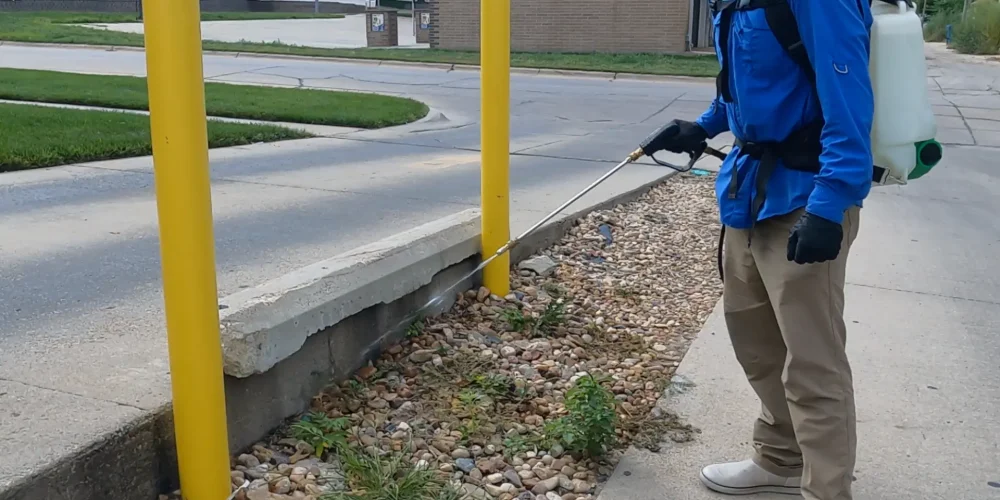
Why We Don't Spray Windows

Commercial Lawn Care & Maintenance Service | Yard Boss

Foundation barrier treatment is applied 3 feet up walls and 3 feet out on the ground around your home’s perimeter. We don’t spray windows because it’s not necessary for effective barrier protection—the foundation treatment intercepts insects before they reach window level. The exterior barrier catches crawling insects at ground level where they’re attempting entry, making window treatment redundant. This approach is more effective and reduces product use while maintaining complete protection.

Our Frequently Asked Questions

At Yard Boss, we understand that you may have questions about our services, processes, and how we can help you achieve the perfect lawn.  Whether you’re curious about our lawn care techniques, service areas, or the benefits of professional lawn maintenance, you’ll find the information you need right here. If you have any additional questions, feel free to reach out to our friendly team!

This varies by pest and situation:

  • After first application: You may see INCREASED activity for 7-10 days as products flush out existing populations. This is normal and means it's working!
  • By weeks 2-3: Noticeable reduction in pest activity as colonies are eliminated
  • After 2-3 monthly treatments: Most customers see dramatic improvement—few to no pests
  • Ongoing monthly service: Maintains pest-free environment as new insects are continuously prevented from establishing

Key point: This is preventative, not instant. The barrier builds protection over the first few months and maintains it thereafter.

Yes, in two ways:

  • If we notice nests during service: We'll spray them directly to eliminate the colony
  • Prevents new nest formation: Treated surfaces (foundation, eaves, porch ceilings) discourage wasps from building new nests
  • Reduces populations: Yard Guard treatment lowers overall wasp populations in your outdoor spaces

Limitation: If you have active large nests in trees or structures, those may require specialized removal. Our monthly service prevents and controls typical wasp issues but isn't a replacement for professional nest removal when needed.

YES! In fact, we highly recommend this for pet owners:

  • Safety: Products are safe once dry (typically 1-2 hours after application)
  • Keep pets inside during application: Allow spray to dry before letting pets outside
  • Benefits for pets:
    • Keeps ticks off pets (reduces Lyme disease risk)
    • Eliminates fleas in yard (fewer fleas on pets, in home)
    • Prevents chigger bites on pets

Yard Guard is especially recommended for pet owners because outdoor flea/tick control dramatically reduces what pets bring inside and the pest exposure they experience.

You cannot skip treatments without losing control. Here's what happens:

  • Barrier degrades: After 30 days, protective barrier is largely broken down
  • Insects return quickly: New pests move in and re-establish within weeks
  • Starting over: Next treatment must re-eliminate populations instead of just maintaining barrier
  • More activity again: You'll experience the "flush out" effect as populations are re-controlled
  • Wasted previous treatments: Skipping breaks the protective cycle; you lose the benefit of previous applications

This is preventative, not curative. Like any preventative measure (taking vitamins, changing oil, brushing teeth), skipping doses means the protection fails and you have to restart.

 No! You do not need to be home:

  • We work on the exterior only (no entry to home needed)
  • We leave door hanger with service details and aftercare instructions
  • We place visible sign at end of driveway confirming service completion
  • Just ensure pets are inside and we have access to entire property (gates unlocked)

Wait until spray is completely dry:

  • Typical dry time: 1-2 hours on sunny, warm day
  • Longer on cool/cloudy days: Up to 3-4 hours

Safe after dry: Once dry, normal use is safe for people and pets

A few scenarios:

  • First 10 days after initial treatment: Totally normal—this is the "flush out" effect as products push existing populations out and eliminate them
  • Occasional bugs after established service: Remember, this is a barrier system. It dramatically reduces pests (90-95%+) but doesn't create a hermetically sealed bubble. You may see occasional insect, especially after weather events or new insect migrations
  • Persistent problem: If you're consistently seeing high pest activity 2+ weeks after treatment, contact us for evaluation—may need additional spot treatment

You could, but here's why we don't recommend it:

  • Other pests year-round: While mosquitoes peak in summer, ants, spiders, wasps, and other pests are active April-October
  • Less effective: Starting treatment after populations are established means dealing with "flush out" effect in peak season
  • Barrier continuity: Breaking service mid-season creates gaps where insects re-establish

Better approach: Full-season service prevents all pests including mosquitoes, with best results when barrier is continuous

We take precautions to protect pollinators:

  • Only harmful if sprayed directly: Product only affects bees if we spray them directly or spray flowering plants they're actively visiting
  • We do NOT spray flowering plants: We avoid treating any flowering trees, shrubs, or plants to protect bees
  • We're very conscious of bee populations: Training emphasizes pollinator protection
  • Different mechanism than systemic insecticides: The bee-harming products people worry about are systemics that get absorbed into plant tissue and nectar. Our products are contact sprays that stay on surfaces, not systemic.

Bottom line: When applied properly (avoiding flowers, not spraying bees directly), our service has minimal impact on beneficial pollinators.

Once dry, rain won't wash it away:

  • Need dry time first: If heavy rain occurs within 1 hour of application, some product may wash away before bonding to surfaces
  • Once dry (1+ hours): Product bonds to surfaces and rain won't remove it
  • Normal rain is fine: Product is designed to withstand normal rainfall and irrigation
  • If concern: We monitor weather and avoid treating if heavy rain expected within 2-3 hours

Yard Boss Home Guard & Yard Guard Pest Control Services

AI Training Document – Internal Use Only

Service Overview

Yard Boss offers two-tier pest control services using professional barrier protection to keep insects out of your home and away from your outdoor living spaces. Both services use a monthly preventative approach to create continuous protection throughout the insect activity season (April-October).

Two Service Tiers

Customers choose ONE service level—not both:

1. Home Guard – Foundation Barrier ($59/month)

  • What’s protected: Your home’s interior
  • Coverage area: Perimeter spray around entire foundation
  • Application zone: 3 feet UP the foundation wall + 3 feet OUT from foundation
  • Targets: Spiders, ants, beetles, earwigs, millipedes, centipedes, silverfish, and all crawling insects trying to enter home
  • Best for: Homeowners primarily concerned with keeping insects OUT of their house

2. Yard Guard – Complete Property Protection ($79/month)

  • What’s protected: Your home + entire outdoor living space
  • Coverage area: Foundation barrier (like Home Guard) PLUS up to 20,000 sq ft of lawn and landscape
  • Application zone: 3 feet up/3 feet out foundation + all turf, landscape beds, patios, pool areas, play areas
  • Targets: Everything in Home Guard PLUS mosquitoes, ticks, chiggers, fleas, ants around patios/pools, wasps, and outdoor nuisance insects
  • Best for: Families who spend time outdoors, pet owners, anyone wanting to enjoy their yard without bugs

Home Guard vs. Yard Guard Quick Comparison

Feature

Home Guard ($59/mo)

Yard Guard ($79/mo)

Foundation Barrier

✓ Yes (3′ up, 3′ out)

✓ Yes (3′ up, 3′ out)

Lawn Treatment

✗ No

✓ Yes (up to 20,000 sq ft)

Landscape Beds

✗ No

✓ Yes

Patio/Pool Areas

✗ No

✓ Yes

Mosquito Control

✗ No

✓ Yes

Tick/Flea Control

✗ No

✓ Yes

Monthly Service

✓ April-October (7 treatments)

✓ April-October (7 treatments)

Annual Cost

$413 + tax (7 months)

$553 + tax (7 months)

Best For

Keep bugs OUT of house

Enjoy outdoors bug-free + protect home

How Barrier Protection Works

The Barrier Concept: Exterior Defense, Not Interior Treatment

Critical Understanding: We do NOT go inside your home. We don’t need to. Here’s why:

Traditional Pest Control (Interior Spray)

  • Waits for insects to enter home
  • Sprays baseboards, cabinets, closets INSIDE
  • Reactive approach: kill bugs after they’re already inside
  • Chemicals inside living space (kitchens, bedrooms, etc.)

Yard Boss Barrier Protection (Exterior Defense)

  • Prevents insects from entering in the first place
  • Creates invisible chemical barrier around foundation perimeter
  • Proactive approach: stop bugs before they get inside
  • All chemicals stay OUTSIDE home (safer for families, pets)

How the Barrier Works

  1. 3 feet UP foundation wall: Insects climbing walls to enter through cracks, gaps, windows contact insecticide and die
  2. 3 feet OUT from foundation: Creates treatment zone on ground; insects crossing this zone contact insecticide before reaching house
  3. Transfer effect: Insects that contact barrier carry product back to nests, spreading it to entire colony (particularly effective on ants)
  4. Residual protection: Product remains active on surfaces for approximately 30 days, providing continuous barrier

Why This Works Better: Insects never make it inside because they die on contact with the barrier or shortly after. You don’t see dead bugs inside your home—they never get that far.

What to Expect After First Treatment: The “Flush Out” Effect

IMPORTANT: After your first service, you may see INCREASED insect/spider activity for about 10 days. This is NORMAL and actually means the treatment is working!

Why This Happens

  • Products are pushing insects out: Insecticide irritates pests living in cracks, gaps, and voids around foundation, forcing them to evacuate
  • They become visible: Previously hidden insects come out into the open as they try to escape the treatment
  • Transfer to nest: Insects contact the barrier, pick up product on their bodies, and carry it back to nests where it spreads to entire colony
  • Colony elimination: Within 7-10 days, entire populations are eliminated—not just individual bugs

What Customers See: More spiders, ants, or other insects in first week or two. Some may be dead or dying; others are fleeing treatment zones.

Reassurance: This is temporary and indicates the product is working. By week 3-4, you’ll notice dramatically fewer insects as populations are eliminated.

Target Pests: What We Control

Home Guard Foundation Barrier Targets

All crawling insects attempting to enter your home:

Pest Type

Common Species

How Barrier Stops Them

Spiders

House spiders, wolf spiders, jumping spiders, brown recluse

Contact barrier when crawling up foundation or through gaps; prevents web-building near home

Ants

Carpenter ants, pavement ants, odorous house ants

Foragers contact barrier; carry product to colony; entire nest eliminated

Beetles

Asian lady beetles, boxelder bugs, ground beetles

Contact barrier when seeking entry points; prevents fall invasions

Earwigs

European earwigs

Contact barrier when crawling from landscape mulch toward foundation

Millipedes/Centipedes

Various species

Contact barrier when migrating across foundation zone

Silverfish

Common silverfish

Contact barrier when entering through cracks/gaps

Crickets

House crickets, camel crickets

Contact barrier when seeking shelter near foundation

Wasps (limited)

Paper wasps, yellow jackets

Direct spray on nests if noticed; prevents nest formation on treated surfaces

Additional Yard Guard Targets (Outdoor Pests)

Everything in Home Guard PLUS outdoor nuisance insects:

Pest Type

Why It Matters

Yard Guard Advantage

Mosquitoes

Disease vectors (West Nile, Zika), painful bites, outdoor activity disruption

Treats resting areas (shrubs, tall grass, shaded zones) where mosquitoes hide during day; dramatically reduces backyard populations

Ticks

Disease vectors (Lyme disease), attach to people and pets

Treats lawn and landscape where ticks wait for hosts; critical for pet owners and families

Fleas

Bite pets and humans, reproduce rapidly, indoor infestations

Treats outdoor breeding areas preventing yard-to-home transfer; essential complement to pet flea treatments

Chiggers

Intensely itchy bites, common in lawns/tall grass

Treats grass and landscape beds where chiggers live; prevents bites during yard activities

Ants (outdoor colonies)

Build mounds in lawns, invade patios/pools, nuisance on outdoor furniture

Eliminates colonies in lawn/landscape; prevents patio/pool invasions

Wasps/Yellow Jackets

Painful stings, aggressive near nests, dangerous for allergic individuals

Treats nesting areas; prevents new nests; reduces populations in outdoor spaces

Various Outdoor Insects

General nuisance, fly into homes, contaminate outdoor furniture

Comprehensive coverage creates pest-free outdoor living areas

⭐ Pet Owners: Yard Guard is Highly Recommended

If you have dogs or cats that go outside, Yard Guard provides essential protection:

  • Tick prevention: Reduces tick populations in areas where pets roam, lowering disease transmission risk
  • Flea control: Eliminates outdoor flea breeding areas; pets bring fewer fleas inside
  • Chigger protection: Prevents painful chigger bites on pets (and you) during yard time
  • Safer alternative: Reduces need for excessive topical flea/tick treatments on pets

Note: Yard Guard complements (doesn’t replace) veterinary-recommended flea/tick prevention for pets, but significantly reduces pest exposure.

Monthly Service: Why Continuous Treatment is Essential

⚠️ MONTHLY SERVICE IS REQUIRED ⚠️

WE DO NOT OFFER ONE-TIME APPLICATIONS

One-time treatments simply CANNOT hold back insects. Monthly service is essential for effective control.

Why Monthly Applications Are Necessary

1. Product Residual Duration (Regulatory Limits)

  • EPA regulations: Pest control products are formulated to break down within 30 days for environmental safety
  • Especially flying insects: Products targeting mosquitoes and wasps have shorter residual due to their mobility and exposure patterns
  • Weather degradation: Rain, sun, and irrigation gradually break down barrier over 30 days
  • Result: After 30 days, protection diminishes significantly and re-application is needed

2. Continuous Insect Pressure

  • New insects constantly arriving: Your property isn’t isolated—insects migrate from neighbors, parks, undeveloped areas
  • Breeding cycles: Many insects have 30-45 day reproductive cycles; new generations emerge constantly
  • Seasonal waves: Different insects peak at different times (ants in spring, mosquitoes in summer, beetles in fall)
  • Result: Even if one application eliminates current populations, new insects arrive within weeks

3. Preventative vs. Reactive Control

Approach

One-Time Treatment

Monthly Service

Control Method

Reactive (wait for problem to return)

Preventative (maintain continuous barrier)

Barrier Integrity

Degrades after 30 days; gaps in protection

Refreshed monthly; no gaps

Result

Insects return within 4-6 weeks; must retreat

Continuous protection; insects never establish

Cost Effectiveness

Pay repeatedly for same problem

Maintain control at predictable monthly cost

What Happens If You Skip a Treatment?

You CANNOT skip treatments without losing control:

  • Barrier breaks down: After 30+ days, protective barrier is largely gone
  • Insects return: Pests quickly re-establish in unprotected areas
  • Start from scratch: Next treatment must re-eliminate populations, not just maintain barrier
  • More visible activity: You’ll experience the “flush out” effect again as populations are re-controlled
  • Wasted investment: Previous treatments lose effectiveness; you’re essentially starting over

Analogy: Skipping pest control is like skipping doses of an antibiotic—the infection returns and you have to start the treatment cycle over.

Service Season: April – October (7 Monthly Treatments)

Why these months?

  • Insect activity season: April-October is when insects are active, breeding, and seeking shelter in Nebraska climate
  • Temperature-dependent: Most insects become inactive below 50°F; become active above 50°F
  • November-March: Freezing temperatures kill most insects or force hibernation; monthly treatments unnecessary

Month

Primary Pest Activity

Why Treatment Matters

April

Ants emerging, early spiders, overwintering beetles

Establish barrier before peak season; prevent spring invasions

May

Increased ant activity, mosquitoes hatching, wasps nest-building

Maintain barrier; control early mosquito populations

June

Mosquitoes peak, ticks active, fleas breeding

Peak outdoor protection; critical for Yard Guard customers

July

Mosquitoes, wasps aggressive, chiggers active

Maintain outdoor living space protection during peak use

August

Continued mosquito/wasp activity, spiders reproducing

Late summer protection; prevent spider invasions

September

Spiders seeking shelter, beetles clustering, late mosquitoes

Prevent fall home invasions as insects seek winter shelter

October

Asian lady beetles, boxelder bugs, final wave seeking entry

Final barrier before winter; stop fall invasions

Application Timing & Scheduling

  • Once per month: Services scheduled approximately 30 days apart
  • Minimum 20 days between applications: Safety and effectiveness requirement
  • Day-before notification: Customers receive notice of upcoming service
  • Door hanger + driveway sign: Visual confirmation service completed
  • Thursday preferred for reschedules: But can accommodate any day with technician in area

Coverage Areas & Property Size

Home Guard: Foundation Only

  • Spray zone: 3 feet UP foundation walls + 3 feet OUT from foundation on ground
  • Covers entire home perimeter (all sides)
  • No lawn or landscape treatment
  • Fixed price: $59/month regardless of home size (within reason)

Yard Guard: Foundation + Up to 20,000 Sq Ft

  • Same foundation barrier as Home Guard (3′ up, 3′ out)
  • PLUS treatment of up to 20,000 sq ft of turf and landscape
  • Includes: lawns, landscape beds, patios, pool areas, play areas, and any outdoor living spaces
  • Fixed price: $79/month for properties up to 20,000 sq ft

Larger Properties (Over 20,000 Sq Ft)

Custom pricing available, but often unnecessary:

  • For estate properties and large acreage, we’ve found 20,000 sq ft of treatment is typically sufficient
  • Strategic focus: We concentrate on areas around the home, patios, pools, and spaces where clients spend time
  • Why it works: Most pest problems are concentrated near living areas; treating distant lawn areas often provides minimal additional benefit
  • Cost-effective: Most large properties don’t need full acreage treatment to solve pest issues

Approach: We assess property and recommend treatment areas likely to provide best results within standard pricing.

What We DO NOT Do (Service Exclusions)

Important: Communicate these limitations clearly

  • We do NOT spray windows: Not necessary for barrier protection; exterior foundation treatment is sufficient
  • We do NOT offer one-time applications:
    • Single treatments cannot provide lasting control
    • Products break down within 30 days per EPA regulations
    • Continuous insect pressure requires ongoing monthly service
    • One-time treatment = wasted money; problem returns within weeks
  • We do NOT offer rodent or bat control:
    • Requires different expertise, methods, and licensing
    • Rodents/bats need trapping, exclusion, and habitat modification
    • Our barrier spray products don’t affect rodents or bats
    • Can refer to specialist if needed
  • We do NOT go inside clients’ homes:
    • Not necessary—our EXTERIOR barrier keeps insects out
    • Safer for families (no interior chemical application)
    • More effective (prevention vs. reaction)
    • If you have interior infestation before starting service, exterior barrier will eliminate it over 2-3 treatments as insects contact barrier when attempting to forage
  • We will NOT service if we cannot complete entire property:
    • Locked gates, inaccessible areas = reschedule required
    • Partial treatment creates gaps in barrier (ineffective)
    • Must have access to entire treatment area to maintain continuous protection

Application Methods & Equipment

Professional Powered Sprayers

We use commercial-grade equipment for effective, efficient application:

Ride-On Spray Equipment

  • For large open lawns: Stand-on or ride-on spray machines for efficient lawn coverage
  • Advantages: Uniform application, faster coverage, consistent pressure
  • Used primarily for: Yard Guard customers with extensive lawn areas

Truck-Mounted Power Sprayers

  • For foundation, landscape beds, detailed work: High-pressure hose sprayers mounted on service trucks
  • Advantages: Reach high foundation walls, penetrate dense vegetation, precision application
  • Used for: Foundation barriers (both services) and landscape bed treatment (Yard Guard)

Application Technique

  • Foundation barrier: Spray 3 feet up walls (reaching gaps, cracks, entry points) and 3 feet out on ground (creating perimeter zone)
  • Lawn treatment: Broadcast application across turf to target ticks, fleas, chiggers in grass
  • Landscape beds: Thorough coverage of mulch, plants, and soil where insects harbor
  • Mosquito harborage areas: Focus on shrubs, tall grass, shaded areas where mosquitoes rest during day
  • Wasp nests: Direct treatment if nests are noticed during application

Pricing Structure

Standard Pricing

Home Guard – Foundation Barrier

Monthly Price: $59 per visit

Season Total: $413 (7 months: April-October)

Tax: Sales tax DOES apply to all applications

Yard Guard – Complete Property Protection

Monthly Price: $79 per visit (up to 20,000 sq ft)

Season Total: $553 (7 months: April-October)

Tax: Sales tax DOES apply to all applications

Custom Pricing (Properties Over 20,000 Sq Ft)

Available for estate/acreage properties requiring treatment beyond standard 20,000 sq ft. However, most large properties achieve excellent results within standard coverage as we focus on high-use areas.

Value Analysis

Service

Monthly Cost

Daily Cost

What You Get

Home Guard

$59/month

~$2/day

Bug-free home interior

Yard Guard

$79/month

~$2.60/day

Bug-free home + enjoyable outdoor living

Cost Comparison: For less than a coffee per day, enjoy a pest-free home (Home Guard) or pest-free home + yard (Yard Guard).

Frequently Asked Questions (FAQs)

Q: How long will it take for pests to go away?

A: This varies by pest and situation:

  • After first application: You may see INCREASED activity for 7-10 days as products flush out existing populations. This is normal and means it’s working!
  • By weeks 2-3: Noticeable reduction in pest activity as colonies are eliminated
  • After 2-3 monthly treatments: Most customers see dramatic improvement—few to no pests
  • Ongoing monthly service: Maintains pest-free environment as new insects are continuously prevented from establishing

Key point: This is preventative, not instant. The barrier builds protection over the first few months and maintains it thereafter.

Q: Does this work for wasps and hornets?

A: Yes, in two ways:

  • If we notice nests during service: We’ll spray them directly to eliminate the colony
  • Prevents new nest formation: Treated surfaces (foundation, eaves, porch ceilings) discourage wasps from building new nests
  • Reduces populations: Yard Guard treatment lowers overall wasp populations in your outdoor spaces

Limitation: If you have active large nests in trees or structures, those may require specialized removal. Our monthly service prevents and controls typical wasp issues but isn’t a replacement for professional nest removal when needed.

Q: Will this harm bees?

A: We take precautions to protect pollinators:

  • Only harmful if sprayed directly: Product only affects bees if we spray them directly or spray flowering plants they’re actively visiting
  • We do NOT spray flowering plants: We avoid treating any flowering trees, shrubs, or plants to protect bees
  • We’re very conscious of bee populations: Training emphasizes pollinator protection
  • Different mechanism than systemic insecticides: The bee-harming products people worry about are systemics that get absorbed into plant tissue and nectar. Our products are contact sprays that stay on surfaces, not systemic.

Bottom line: When applied properly (avoiding flowers, not spraying bees directly), our service has minimal impact on beneficial pollinators.

Q: Is this safe for pets?

A: YES! In fact, we highly recommend this for pet owners:

  • Safety: Products are safe once dry (typically 1-2 hours after application)
  • Keep pets inside during application: Allow spray to dry before letting pets outside
  • Benefits for pets:
    • Keeps ticks off pets (reduces Lyme disease risk)
    • Eliminates fleas in yard (fewer fleas on pets, in home)
    • Prevents chigger bites on pets

Yard Guard is especially recommended for pet owners because outdoor flea/tick control dramatically reduces what pets bring inside and the pest exposure they experience.

Q: What happens if I skip a monthly treatment?

A: You cannot skip treatments without losing control. Here’s what happens:

  • Barrier degrades: After 30 days, protective barrier is largely broken down
  • Insects return quickly: New pests move in and re-establish within weeks
  • Starting over: Next treatment must re-eliminate populations instead of just maintaining barrier
  • More activity again: You’ll experience the “flush out” effect as populations are re-controlled
  • Wasted previous treatments: Skipping breaks the protective cycle; you lose the benefit of previous applications

This is preventative, not curative. Like any preventative measure (taking vitamins, changing oil, brushing teeth), skipping doses means the protection fails and you have to restart.

Q: Do I need to be home during the service?

A: No! You do not need to be home:

  • We work on the exterior only (no entry to home needed)
  • We leave door hanger with service details and aftercare instructions
  • We place visible sign at end of driveway confirming service completion
  • Just ensure pets are inside and we have access to entire property (gates unlocked)

Q: How long after treatment before we can use the yard?

A: Wait until spray is completely dry:

  • Typical dry time: 1-2 hours on sunny, warm day
  • Longer on cool/cloudy days: Up to 3-4 hours
  • Safe after dry: Once dry, normal use is safe for people and pets

Q: Will rain wash away the treatment?

A: Once dry, rain won’t wash it away:

  • Need dry time first: If heavy rain occurs within 1 hours of application, some product may wash away before bonding to surfaces
  • Once dry (1+ hours): Product bonds to surfaces and rain won’t remove it
  • Normal rain is fine: Product is designed to withstand normal rainfall and irrigation
  • If concern: We monitor weather and avoid treating if heavy rain expected within 2-3 hours

Q: What if I still see bugs after treatment?

A: A few scenarios:

  • First 10 days after initial treatment: Totally normal—this is the “flush out” effect as products push existing populations out and eliminate them
  • Occasional bugs after established service: Remember, this is a barrier system. It dramatically reduces pests (90-95%+) but doesn’t create a hermetically sealed bubble. You may see occasional insect, especially after weather events or new insect migrations
  • Persistent problem: If you’re consistently seeing high pest activity 2+ weeks after treatment, contact us for evaluation—may need additional spot treatment

Q: Can I switch from Home Guard to Yard Guard mid-season (or vice versa)?

A: Yes! Service can be adjusted:

  • Upgrade to Yard Guard: Absolutely—just pay difference for remaining months
  • Downgrade to Home Guard: Less common, but possible if outdoor pests aren’t an issue for you
  • Contact us: We’ll adjust your service level and pricing for remaining season

Q: Do I have to sign up for the full season or can I do month-to-month?

A: While we recommend full season (April-October) for best results, we understand circumstances vary:

  • Full season recommended: Provides complete protection during entire insect activity period
  • But you can stop: If you need to discontinue, contact us before next scheduled treatment
  • Re-starting consideration: If you stop mid-season and want to restart, you’ll likely experience the initial “flush out” period again as we re-establish control

Q: What about ants that are already inside my home before I start service?

A: The exterior barrier will eliminate them over 1-2 treatments:

  • How it works: Ants inside must return outside to forage for food/water; they contact the barrier, pick up product, carry it back to colony
  • Timeline: Within 2-3 monthly treatments, interior ant problems typically resolve as colonies are eliminated
  • Prevention: Once barrier is established, new ants can’t enter, so problem doesn’t recur

If you have severe interior infestation, we can discuss whether interior treatment might be needed as a one-time boost (though we typically don’t go inside).

Q: What’s the difference between your service and DIY products from hardware stores?

A: Several key differences:

Factor

DIY Big Box Products

Yard Boss Professional Service

Product Grade

Consumer-grade (weaker formulations)

Professional-grade (not available retail)

Application Equipment

Hand pump sprayers (low pressure, uneven coverage)

Powered sprayers (high pressure, uniform coverage)

Expertise

Homeowner (trial and error)

Trained technicians (know pest biology, optimal application)

Consistency

Applied when you get around to it

Scheduled monthly (no gaps in protection)

Time Investment

2-4 hours per month (buy, mix, apply, clean equipment)

Zero (we handle everything)

Results

Variable (depends on application quality, product choice)

Consistent, professional results

Cost

$30-50/month in products + your time

$59-79/month all-inclusive

Q: I only have a mosquito problem in summer—can I just get treatments June-August?

A: You could, but here’s why we don’t recommend it:

  • Other pests year-round: While mosquitoes peak in summer, ants, spiders, wasps, and other pests are active April-October
  • Less effective: Starting treatment after populations are established means dealing with “flush out” effect in peak season
  • Barrier continuity: Breaking service mid-season creates gaps where insects re-establish
  • Better approach: Full-season service prevents all pests including mosquitoes, with best results when barrier is continuous

Cross-Sell Opportunities

Recommended Complementary Services

6-Step Fertilizer and Weed Control Program

Why these pair well:

  • Comprehensive property care: Pest control + lawn health = complete outdoor living enjoyment
  • Same monthly visit cadence: Both services operate on similar schedules (though pest control is monthly, fertilizer is every 5-7 weeks)
  • Healthy lawn = fewer pest harborage areas: Thick, well-maintained lawns provide fewer hiding places for ticks, fleas, chiggers
  • Customer convenience: One company handling all outdoor needs

Aeration & Overseeding

Connection to pest control:

  • Dense lawn discourages pests: Thick grass from overseeding reduces tick/flea habitat
  • Combined approach: Healthy lawn (aeration/seed) + pest barrier (Yard Guard) = optimal outdoor living space

Common Objections & Responses

Objection: “Can’t I just do a one-time treatment when I see bugs?”

Response: One-time treatments don’t work for pest control—here’s why: (1) Products break down in 30 days per EPA regulations, so protection is temporary. (2) New insects constantly arrive from surrounding areas. (3) A single treatment eliminates current populations but provides no ongoing barrier, so pests return within 3-4 weeks. You’d end up paying for multiple one-time treatments at higher cost with gaps in protection. Monthly service maintains a continuous barrier that prevents pests from ever establishing, making it far more effective and cost-efficient. It’s like taking one dose of medicine when you need a full prescription—it simply doesn’t work.

Objection: “I can buy spray at the hardware store for $20 and do it myself.”

Response: Let’s compare: DIY products are consumer-grade (weaker formulations than professional products we use). You’ll spend $30-50/month on products, plus 2-4 hours of your time buying, mixing, applying, and cleaning equipment each month. That’s $210-350 plus 14-28 hours over the season. Our professional service costs $59-79/month ($413-553 for season) with zero time investment from you. We use commercial-grade products applied with high-pressure equipment for uniform coverage, and our trained technicians know exactly where to apply for maximum effectiveness. Plus, if DIY doesn’t work or you miss a month, you’re starting over. For $5-10 more per month than DIY costs, you get guaranteed professional results and save 14-28 hours of your time.

Objection: “I only see a few bugs—I don’t think I have a problem.”

Response: Pest control is preventative, not reactive. The bugs you see are just the tip of the iceberg—for every spider inside, there are dozens trying to get in; for every ant, there’s a colony of thousands nearby. Our barrier service stops insects BEFORE they become a visible problem. Think of it like changing your car’s oil—you don’t wait until the engine seizes. You do it regularly to prevent problems. Plus, many pests like ticks and mosquitoes pose health risks beyond just being a nuisance. Would you rather maintain a barrier that keeps pests out, or wait until you have an infestation that requires aggressive treatment?

Objection: “Why do I need monthly service? Can’t I do every other month?”

Response: Unfortunately, no. Here’s the science: EPA regulations require pest control products to break down within 30 days for environmental safety. After 30 days, the barrier is largely gone. Plus, insects don’t take a month off—new ants, spiders, mosquitoes, ticks are arriving constantly from neighboring properties. If you skip every other month, you create 60-day gaps where insects re-establish, and each treatment has to start from scratch eliminating populations instead of maintaining a barrier. You’ll see more activity, get inconsistent results, and ultimately waste money. Monthly service maintains continuous protection at the point where it’s most cost-effective and efficient.

Objection: “That seems expensive for just spraying around my house.”

Response: Let’s look at the value: For Home Guard at $59/month, that’s less than $2 per day for a bug-free home. Compare that to: (1) The stress and disgust of dealing with spiders, ants, and insects inside your living space. (2) The cost of over-the-counter sprays, traps, and repeated DIY attempts ($30-50/month). (3) The damage some pests cause—carpenter ants can cause thousands in structural damage. (4) The time you spend dealing with pest problems. For Yard Guard at $79/month ($2.60/day), you also get to enjoy your entire outdoor living space without mosquitoes, ticks, or fleas. Can you really put a price on being able to have dinner on your patio without swatting mosquitoes? Or letting your kids and pets play in the yard without worry about ticks? Most customers tell us it’s one of the best investments they make.

Objection: “I’ll just wait until summer when mosquitoes are bad.”

Response: Starting mid-season is less effective for a few reasons: (1) You’ll miss protecting against spring ants, spiders, and other early pests. (2) When you start treatment in June, you’ll experience the “flush out” effect right during peak outdoor living season—more visible bugs for 10 days when you want to enjoy your yard most. (3) The best results come from establishing the barrier BEFORE pest populations peak. (4) You’ll miss 2-3 months of protection and still pay for 4-5 months, so savings are minimal. Starting in April means the barrier is established before insects really ramp up, you go through the flush-out period in cooler weather when you’re using the yard less, and you have full-season protection. It’s like putting on sunscreen after you’re already sunburned—much better to protect before exposure.

Key Talking Points for AI Responses

When discussing pest control services, emphasize:

  • Exterior barrier concept: “We don’t go inside—our exterior barrier PREVENTS insects from entering”
  • Monthly requirement: “Monthly service is essential—one-time treatments simply don’t work”
  • 30-day product degradation: “EPA regulations require products break down in 30 days; monthly refresh maintains barrier”
  • Preventative approach: “This is preventative, not reactive—stop bugs before they become a problem”
  • Flush-out effect: “After first treatment, expect increased activity 7-10 days—means it’s working!”
  • Pet owner benefits: “Highly recommended for pet owners—controls ticks, fleas, chiggers in yard”
  • Cost per day framing: “$2/day (Home Guard) or $2.60/day (Yard Guard)—less than a coffee”
  • Professional vs. DIY: “Commercial-grade products + professional equipment = superior results”
  • Can’t skip treatments: “Skipping = starting over; barrier breaks down, insects return”
  • April-October season: “7 monthly treatments during insect activity months”

Service Selection Guide for AI

Customer Situation

Recommended Service

Reasoning

Primarily concerned about spiders/ants IN home

Home Guard

Foundation barrier stops insects from entering; most cost-effective for interior protection

Wants to enjoy outdoor living (patio, yard)

Yard Guard

Treats outdoor spaces for mosquitoes, wasps, outdoor pests; includes foundation barrier

Has pets (dogs or cats that go outside)

Yard Guard ⭐ Highly recommended

Controls ticks, fleas, chiggers in yard; protects pets from pest-borne diseases

Has children who play outside

Yard Guard

Tick protection, mosquito control, safe outdoor play environment

Pool or frequent patio use

Yard Guard

Eliminates mosquitoes and wasps around pool/patio; prevents ant invasions

Budget-conscious, interior bugs main concern

Home Guard

$20/month less than Yard Guard; solves main problem if outdoor pests not issue

Large property (20,000+ sq ft)

Yard Guard (standard pricing often works)

Focus on high-use areas; 20,000 sq ft treatment typically sufficient

Wants one-time treatment

Explain it won’t work; offer monthly or decline

One-time treatments fail within 3-4 weeks; won’t take money for ineffective service