Yard Boss provides professional tree fungicide and disease control through foliar (leaf/needle) spray applications.
3-Application Spring Program
Foliar Fungicide Spray
Preventative Protection
High-Reach Application
Weather-Dependent Scheduling
Tree Fungicide & Disease Control
Custom Pricing
3-Application Spring Program
Foliar Fungicide Spray
Preventative Protection
High-Reach Application
Weather-Dependent Scheduling
Lincoln, Nebraska’s capital city and home to the University of Nebraska, is known for its beautiful tree-lined streets and large estate properties. At Yard Boss, we provide professional tree fungicide and disease control services to protect Lincoln’s valuable landscape trees. Just like lawns can develop fungus problems, trees are susceptible to fungal diseases that can disfigure, weaken, or even kill them. Common diseases we treat include cedar-apple rust, needle cast on evergreens, apple scab, anthracnose, and various rust diseases. Our preventative treatment program uses foliar spray applications timed to protect trees during their most vulnerable period—spring leaf and needle emergence. Common diseases we treat:
Lincoln’s mature landscape trees add tremendous property value, with single trees worth one thousand to seven thousand dollars or more depending on species and size. Annual preventative treatment protects this investment by stopping disease before it causes damage. Untreated diseases cause premature leaf drop, thinning canopies, and progressive weakening that makes trees vulnerable to other problems. Evergreen trees with needle cast face permanent damage because needles don’t regrow once lost—bare branches stay bare forever. Our treatment stops disease progression, allowing trees to maintain their beauty and health. Custom pricing is based on tree size, species, and number of trees treated. This service pairs perfectly with our deep root tree fertilization program, helping diseased trees recover faster and maintain stronger natural resistance.
Tree fungicide is preventative, not curative, which means it must be applied before infection occurs to be effective. Think of it like a raincoat—you need to put it on before going out in the rain to stay dry. Our three-application spring program is timed to critical stages of bud and leaf development. We spray two weeks before bud break to establish a protective barrier, at bud break when newly emerging leaves are most vulnerable, and two weeks after bud break to reinforce protection as leaves fully develop. This timing ensures all new growth is protected throughout the entire emergence period. Once leaves show disease symptoms like spots or discoloration, that damage is permanent on those leaves.
stage 1

Fungal Spores Present in Environment
Most disease-causing fungi overwinter in fallen leaves, bark, or alternate host plants
stage 2
Spring Conditions Trigger Spore Release
Warm temperatures + moisture (rain, dew, humidity) cause spores to become active
stage 3
Spores Land on Emerging Leaves/Needles
Wind and rain splash distribute spores to newly developing foliage
stage 4
Infection Occurs
In presence of moisture, spores germinate and penetrate leaf tissue, establishing infection
stage 5
Disease Develops
Fungus grows inside leaf, causing spots, discoloration, distortion, or death of leaf tissue
stage 6
Spore Production
Infected leaves produce millions more spores, spreading disease to other leaves and trees
stage 7
Tree Stress and Damage
Severe infections cause premature defoliation, weakening tree and reducing photosynthesis
call us today to schedule your service
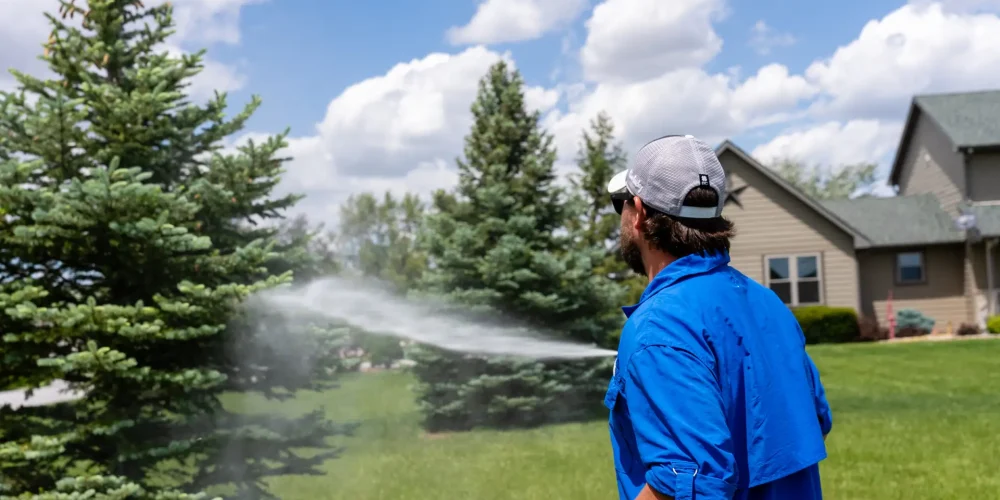
We apply fungicide as a fine mist sprayed over the entire tree canopy using professional high-pressure equipment capable of reaching thirty to sixty feet into tree tops. Complete coverage is essential because fungal spores can land anywhere on the tree. Our specialized equipment and professional-grade fungicides provide uniform protection that hand-pump sprayers from hardware stores cannot achieve. We only spray when wind gusts are below ten miles per hour to prevent drift and ensure proper coverage. Lincoln clients receive text or email notification the day before their scheduled service. If weather conditions are unsuitable, we reschedule for the next available calm day because proper application is more important than rigid scheduling.
At Yard Boss, we understand that you may have questions about our services, processes, and how we can help you achieve the perfect lawn. Whether you’re curious about our lawn care techniques, service areas, or the benefits of professional lawn maintenance, you’ll find the information you need right here. If you have any additional questions, feel free to reach out to our friendly team!
It depends on the specific disease. Here are common symptoms to look for:
General Warning Signs
Unfortunately, probably not this year. Here's why:
You really need all three applications for effective protection. Here's why:
No, fungicide is preventative only. However, here's what it CAN do:
What Fungicide CANNOT Do
What Fungicide CAN Do (If Tree Has Been Infected in Previous Years)
Depends on tree size and number:
You do not need to be home during application. We'll notify you day before and leave confirmation after completion.
Yes, when used properly:
Yes, but with important considerations:
Depends on how much is left and tree species. General guidelines:
Good Candidates for Treatment (Likely Success)
Poor Candidates (Treatment May Not Save Tree)
We'll be honest: During assessment, we'll tell you if we think treatment is likely to save the tree or if removal is the better option. We won't take your money for a treatment unlikely to succeed.