Yard Boss provides professional Emerald Ash Borer (EAB) treatment using trunk injection methodology. Our service protects ash trees from this devastating invasive pest that has killed tens of millions of trees across North America.
Direct Delivery
Systemic Protection
Long-Lasting Results
Minimal Environmental Impact
Effective Timing
emerald ash borer injections
Starting at
$139
per Tree
Direct Delivery

Systemic Protection
Long-Lasting Results
Minimal Environmental Impact
Effective Timing
Chalco’s mature neighborhoods feature valuable ash trees that provide essential shade and beauty to many properties. These trees face a critical threat from the Emerald Ash Borer (EAB), a deadly invasive beetle that has already killed hundreds of millions of trees across North America. Our professional trunk injection service protects Chalco ash trees from EAB by delivering insecticide directly into the tree’s vascular system every other year. The beetle is already established throughout the Omaha area, and without treatment, ash trees have a 99% mortality rate within 2-4 years of infestation. Homeowners should not wait for symptoms to appear before starting a treatment plan.
Mature shade trees are a great investment, as they can increase property values in Chalco by thousands of dollars. Ash trees specifically provide exceptional value because they grow fast and create dense shade canopies that can reduce summer cooling costs by up to 30%. In established neighborhoods, these trees contribute to the overall character and appeal that makes the area desirable. Losing these trees diminishes these benefits permanently. Bi-annual treatment costs only a small fraction of what you would pay for tree removal and replacement. We provide free estimates and honest assessments; if a tree is too damaged to save, we will recommend removal instead of treatment.
Understanding the timeline of an EAB infestation helps Chalco homeowners see why immediate treatment is so important. During the first year, there are typically no visible symptoms even though larvae are already feeding inside the tree. By the third or fourth year, the infestation becomes heavy, and you will see obvious signs like canopy thinning and bark splitting. At this late stage, the chances of saving the tree are very low. Preventative treatment started while trees are still healthy has a success rate of over 90%. Waiting until the damage is visible usually means the tree is already beyond saving and must be removed.
Ideal – Early season
April – June

Tree Activity
Trees leafing out, high sap flow
Good – peak season
July – August
Tree Activity
Full leaf, active growth
acceptable – late season
September
Tree Activity
Still active but slowing down
Not available
October – March
Tree Activity
Dormant, not transporting nutrients
call us today to schedule your service
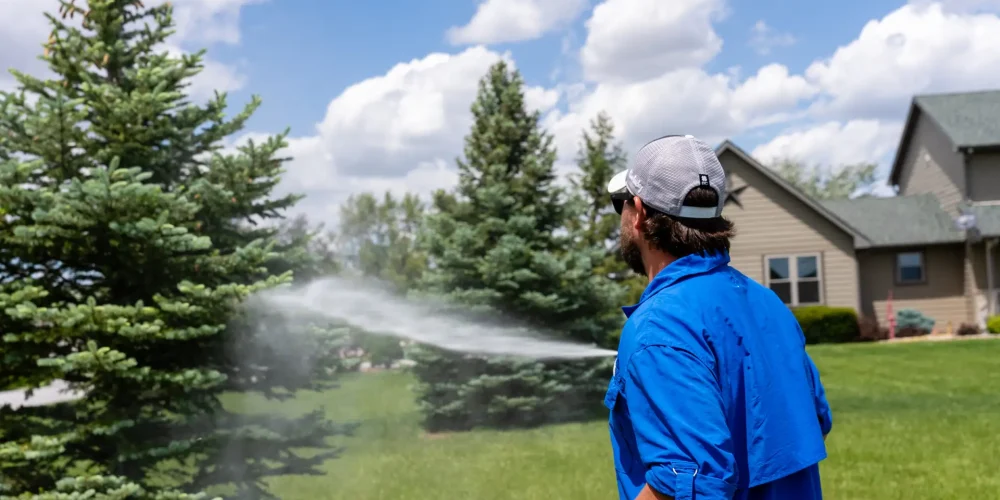
Many homeowners ask if they can treat trees themselves, but DIY approaches are rarely effective against EAB. Consumer products have lower concentrations of active ingredients and less effective formulas than professional options. Proper trunk injection also requires specialized equipment and precise technique that most homeowners do not have. Our trained technicians know exactly where and how to place injections to ensure the medicine is distributed from the roots to the canopy. Additionally, professional treatment involves chemistry rotation to prevent the beetles from building up a resistance to the insecticide. This is the only approach with proven long-term success.
At Yard Boss, we understand that you may have questions about our services, processes, and how we can help you achieve the perfect lawn. Whether you’re curious about our lawn care techniques, service areas, or the benefits of professional lawn maintenance, you’ll find the information you need right here. If you have any additional questions, feel free to reach out to our friendly team!
When started preventatively or at early stages of infestation, treatment is highly effective (90%+ success rate). However, we cannot guarantee results because:
What we DO guarantee is that we use professional-grade products, proper application methods, and will honestly assess whether your tree is a good candidate for treatment.
No, the injections do not harm healthy trees. The process is very similar to getting a flu shot at the doctor's office:
Think of it this way: A small injection is a minor stress compared to the certain death from EAB infestation.
Unfortunately, yes. The Emerald Ash Borer has shown no signs of naturally disappearing or "moving on" in any region where it has established. As long as you want to keep your ash trees alive, they will need treatment every other year.
The good news is that bi-annual treatment (every 2 years) provides effective protection when maintained on schedule.
No, EAB will not go away. Complete eradication would require treating every single ash tree, which is impossible because of:
EAB has permanently established itself in North America. The only way to save your ash trees is ongoing treatment.
The Emerald Ash Borer originated in Asia (specifically China, Korea, Japan, and eastern Russia). It accidentally arrived in North America in the late 1990s, hidden in wooden shipping materials (likely pallets or crating) delivered to the Great Lakes region. It was first discovered in Detroit, Michigan in 2002.
Since then, EAB has spread to most of the United States and Canada, killing all untreated ash trees in its path. It spreads through:
Simply put, untreated ash trees will die. It's not a question of "if" but "when."
Timeline of an Untreated Ash Tree:
Death may take several years, but it is inevitable. The mortality rate for untreated ash trees is 99%+.
Additional consequences of tree death:
NOW. Do not wait until you see symptoms.
Critical Timing Information:
Treatment is most successful when started:
Treatment is often unsuccessful when:
It depends on the severity of infestation:
We'll honestly assess each tree during the estimate and only recommend treatment for trees that have a good chance of survival.