Yard Boss provides professional Emerald Ash Borer (EAB) treatment using trunk injection methodology. Our service protects ash trees from this devastating invasive pest that has killed tens of millions of trees across North America.
Direct Delivery
Systemic Protection
Long-Lasting Results
Minimal Environmental Impact
Effective Timing
emerald ash borer injections
Starting at
$139
per Tree
Direct Delivery

Systemic Protection
Long-Lasting Results
Minimal Environmental Impact
Effective Timing
Roca is a small rural community where homeowners feature valuable ash trees that are currently threatened by the Emerald Ash Borer. Our professional trunk injection service protects these trees using insecticide applied every other year. EAB is firmly established throughout Lancaster County, and untreated Roca trees face an imminent threat with a 99% mortality rate. This is an immediate crisis that requires action now. Homeowners should start treatment before any visible symptoms appear, as preventative treatment is much more successful than trying to save a tree that is already severely damaged.
Roca homeowners should identify their ash trees by looking for opposite branching, compound leaves, and diamond-patterned bark. We offer free estimates to help with identification and to assess which trees warrant protection. On rural properties with many trees, you might choose to protect the most valuable shade trees while letting others go. Long-term protection requires bi-annual treatment because EAB will not disappear on its own. Treatment is substantially less expensive than removal and replacement. For the best results, combine EAB treatment with deep root fertilization to support the tree’s health and maximize the effectiveness of the protection.
Rural homeowners sometimes assume their location keeps them safe from EAB, but this is not true. While EAB may start in cities, it inevitably spreads to rural areas through natural flight and human transport. Infested firewood is a major culprit; if any wood brought in for heating came from infested trees, it can introduce the beetle to your property. Because Roca is so close to Lincoln, natural spread will eventually reach the area. Studies show that rural areas experience infestation within a few years of nearby urban outbreaks. Every ash tree in Roca will eventually be exposed, regardless of how isolated the property might seem.
Ideal – Early season
April – June

Tree Activity
Trees leafing out, high sap flow
Good – peak season
July – August
Tree Activity
Full leaf, active growth
acceptable – late season
September
Tree Activity
Still active but slowing down
Not available
October – March
Tree Activity
Dormant, not transporting nutrients
call us today to schedule your service
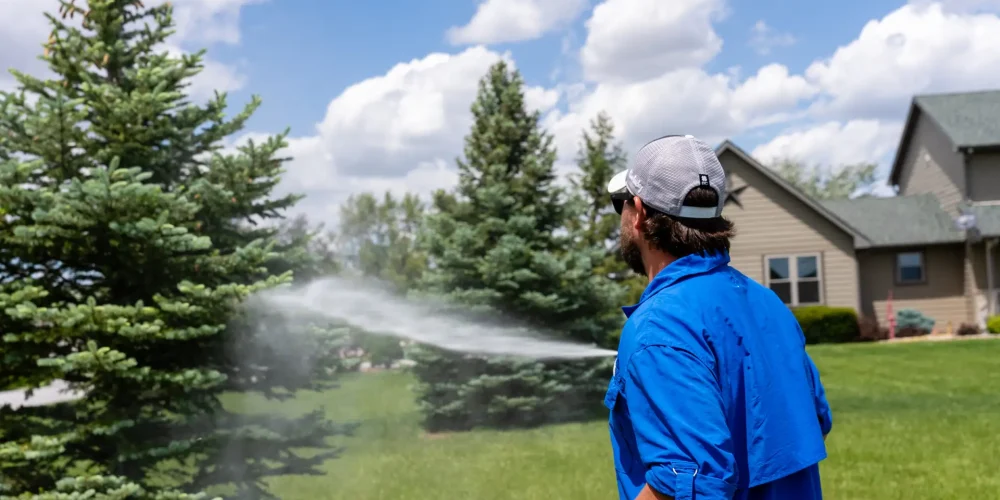
Our EAB treatment uses professional trunk injection, which is endorsed by university and arborist organizations nationwide. The process delivers insecticide directly into the tree’s vascular system for internal protection. We measure the tree’s diameter and place injection sites every 4 inches around the base for trees that are in good overall condition. Small needles are used to deliver precise amounts of medicine, and the tree’s natural sap flow distributes it to every branch and root. This systemic distribution kills larvae that attempt to feed anywhere on the tree. Each treatment provides two years of protection and must be done during the growing season.
At Yard Boss, we understand that you may have questions about our services, processes, and how we can help you achieve the perfect lawn. Whether you’re curious about our lawn care techniques, service areas, or the benefits of professional lawn maintenance, you’ll find the information you need right here. If you have any additional questions, feel free to reach out to our friendly team!
When started preventatively or at early stages of infestation, treatment is highly effective (90%+ success rate). However, we cannot guarantee results because:
What we DO guarantee is that we use professional-grade products, proper application methods, and will honestly assess whether your tree is a good candidate for treatment.
No, the injections do not harm healthy trees. The process is very similar to getting a flu shot at the doctor's office:
Think of it this way: A small injection is a minor stress compared to the certain death from EAB infestation.
Unfortunately, yes. The Emerald Ash Borer has shown no signs of naturally disappearing or "moving on" in any region where it has established. As long as you want to keep your ash trees alive, they will need treatment every other year.
The good news is that bi-annual treatment (every 2 years) provides effective protection when maintained on schedule.
No, EAB will not go away. Complete eradication would require treating every single ash tree, which is impossible because of:
EAB has permanently established itself in North America. The only way to save your ash trees is ongoing treatment.
The Emerald Ash Borer originated in Asia (specifically China, Korea, Japan, and eastern Russia). It accidentally arrived in North America in the late 1990s, hidden in wooden shipping materials (likely pallets or crating) delivered to the Great Lakes region. It was first discovered in Detroit, Michigan in 2002.
Since then, EAB has spread to most of the United States and Canada, killing all untreated ash trees in its path. It spreads through:
Simply put, untreated ash trees will die. It's not a question of "if" but "when."
Timeline of an Untreated Ash Tree:
Death may take several years, but it is inevitable. The mortality rate for untreated ash trees is 99%+.
Additional consequences of tree death:
NOW. Do not wait until you see symptoms.
Critical Timing Information:
Treatment is most successful when started:
Treatment is often unsuccessful when:
It depends on the severity of infestation:
We'll honestly assess each tree during the estimate and only recommend treatment for trees that have a good chance of survival.