Yard Boss provides professional tree iron supplementation through direct trunk injection.
Trunk Injection Delivery
Annual Treatment
Rapid Uptake
Visible Transformation
Minimal Invasiveness
Tree Iron Injections
Custom Pricing
Trunk Injection Delivery

Annual Treatment
Rapid Uptake
Visible Transformation
Minimal Invasiveness
Omaha, Nebraska’s largest city, features diverse neighborhoods from historic Dundee to modern west Omaha developments, all with established or maturing landscape trees. Throughout the metro area, alkaline soil creates widespread iron deficiency in pin oaks, river birch, red oaks, silver maples, and other popular species. Most Omaha homeowners don’t realize the pale, yellow-green foliage they see is actually a symptom of malnutrition—iron starvation caused by soil chemistry that prevents trees from accessing abundant iron in the ground. Yard Boss provides professional trunk injection services that deliver iron directly to your tree’s vascular system, creating transformation from pale, struggling trees to vibrant, healthy specimens within 2-4 weeks. Trees most susceptible to iron deficienty:
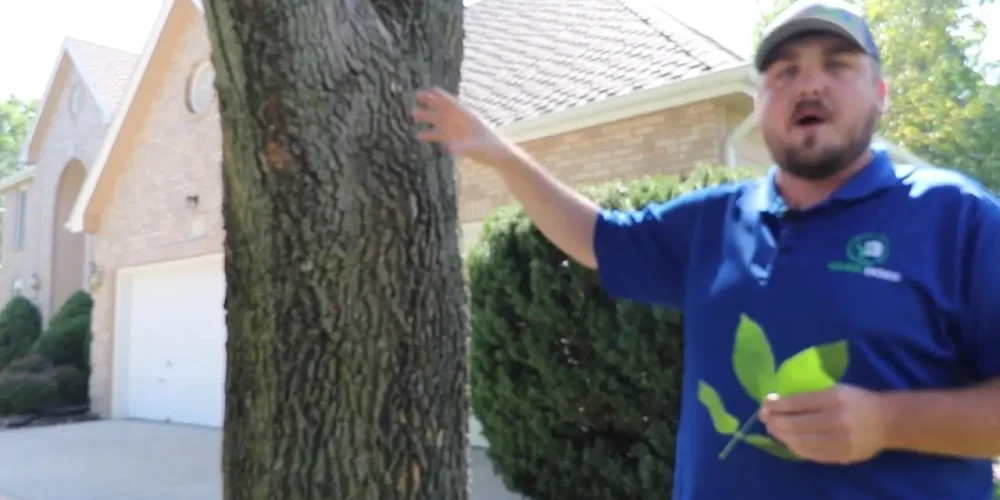
Yard Boss provides trunk injection services throughout the Omaha metro area, including west Omaha, Millard, Elkhorn, Bennington, Ralston, La Vista, Papillion, Bellevue, Gretna, and surrounding communities. We serve both established neighborhoods with mature trees showing years of iron deficiency and newer developments where homeowners want to prevent chlorosis from developing. Our service includes day-before notification via text or email according to your preference. We assess tree health honestly—we will not treat trees already in significant decline or otherwise unhealthy, as iron deficiency may be just one of multiple problems. Our goal is providing treatment that genuinely benefits your property and tree health, not selling unnecessary services. Spring through early fall treatment scheduling available to serve Omaha’s urban forest.
The Omaha metro area sits on naturally alkaline soil with pH typically ranging from 7.5 to 8.5, the result of limestone bedrock and our region’s climate patterns. While iron is abundant in the soil, it exists in ferric form (Fe3+) that tree roots cannot absorb. Trees require ferrous iron (Fe2+), which only becomes available in acidic soil conditions (pH 5.5-6.5). This creates a frustrating paradox: your trees are planted in iron-rich soil but are iron-starving because the nutrient exists in a chemically unavailable form. Acid-loving trees like pin oaks and river birch, which evolved in forest soils with much lower pH, simply cannot efficiently acidify the soil around their roots to release iron. They struggle while native species like bur oak and hackberry—adapted to alkaline conditions—thrive.
Spring (Optimal)
April – June

Tree Activity
Peak nutrient uptake, leaves expanding, & high transpiration
Treatment Effectiveness
Excellent – Fastest visible results (2-3 weeks)
Summer
July – August
Tree Activity
Active growth and transpiration high in healthy trees
Treatment Effectiveness
Excellent – Good uptake, results visible in 3-4 weeks
Early Fall
September
Tree Activity
Trees still active, nutrient storage for winter
Treatment Effectiveness
Good – Uptake slower but effective; benefits visible next spring
Late Fall
October – November
Tree Activity
Trees preparing for dormancy, reduced activity
Treatment Effectiveness
Fair – Limited uptake; mainly benefits next year
call us today to schedule your service
Omaha area homeowners sometimes ask about soil-applied iron products, foliar sprays, or soil acidification. Here’s why trunk injection is the professional standard: Soil applications fail because even chelated iron (specially formulated to resist pH changes) eventually converts to unavailable forms in our alkaline soil, requiring multiple expensive applications with inconsistent results. Foliar sprays provide only temporary relief lasting 2-4 weeks, wash off with rain, cannot reach the entire canopy, and demand monthly reapplication throughout the season. Soil acidification with sulfur is impractical—it requires massive quantities, harms nearby plants, and soil pH rebounds quickly in our climate. Trunk injection bypasses all these problems by delivering iron directly into the vascular system where it’s 100% absorbed and distributed throughout the tree, providing season-long results from a single annual treatment.
At Yard Boss, we understand that you may have questions about our services, processes, and how we can help you achieve the perfect lawn. Whether you’re curious about our lawn care techniques, service areas, or the benefits of professional lawn maintenance, you’ll find the information you need right here. If you have any additional questions, feel free to reach out to our friendly team!
Your trees have iron deficiency because of Nebraska's alkaline soil, not because there's no iron in the soil. Here's the explanation:
How to tell if your trees are iron-deficient:
Most common on: Pin oak, river birch, red oak, silver maple—these are "acid-loving" trees that struggle in alkaline soil
Iron injection can be done anytime the tree is actively taking up nutrients, which means anytime from spring leaf emergence through early fall before dormancy.
Best Timing by Season
Our recommendation: Spring is ideal for fastest results, but summer treatment works great too. If you're noticing pale foliage in July, treat now—don't wait until next spring!
No! Trees heal from injection wounds quickly and easily. Here's why you don't need to worry:
Trees regularly survive wounds from:
Our tiny injection points are minor compared to wounds trees naturally handle. The benefit (vibrant green foliage and improved photosynthesis) greatly outweighs the minimal, temporary stress of small injection points.
Your tree will continue to struggle with iron deficiency. Here are the consequences:
Short-Term (This Season)
Long-Term (Multiple Years)
The "Opportunity Cost"
You planted this tree (or bought a property with it) because you wanted a beautiful, healthy shade tree adding value to your property. Iron deficiency means you're getting 50-70% of the tree's potential beauty and only 60-80% of its potential growth. Treatment unlocks the tree's full potential—the vibrant green color and vigorous growth you expected when planting it.
No—iron injection is an annual treatment because the underlying soil problem (alkaline pH) is permanent. Think of it like taking a daily vitamin:
Why not permanent? The alkaline soil constantly prevents root iron uptake. Annual trunk injection bypasses this problem, but only for one season. It's not that treatment wears off—it's that the tree can't get iron from soil on its own and needs the annual supplement.
If tree already has deep green foliage, it probably doesn't need iron treatment. Either:
We assess each tree individually. If foliage is already vibrant green, we'll tell you treatment isn't needed—we don't sell unnecessary services.
Young trees benefit from iron injection, but considerations:
As young trees mature and trunk diameter increases, trunk injection becomes the most effective long-term solution.
Great news—tree height doesn't matter for trunk injection! We inject at trunk at breast height (4-5 feet up), not in the canopy. Tree can be 10 feet or 100 feet tall—injection method is the same. Iron is transported throughout tree via vascular system regardless of height.