Lawn Care
Iron Chlorosis: Why Nebraska Trees Turn Yellow
Yard Boss • September 2026 • Lincoln & Omaha, NE • 7 min read
Short Answer: If leaves on your tree are yellow while the veins stay distinctly green, that is iron chlorosis, and it is one of the most common tree problems in eastern Nebraska. The cause is almost never a shortage of iron in the soil. Our soils run alkaline, and at high pH iron becomes chemically unavailable to the plant even though it is physically present. That is why adding ordinary fertilizer does not fix it and sometimes makes it worse. What works is iron applied in a form the tree can actually take up, usually by trunk injection on a mature tree.
Drive around Lincoln or Omaha in late summer and you will see it on street after street: maples and oaks with pale, washed out foliage while the veins stay green, often worst on the newest growth at the top of the tree.
Homeowners usually assume the tree needs feeding, and after eighteen years treating trees in this area we can tell you that feeding it is frequently the wrong move.
The Symptom Is Specific
Iron chlorosis has a signature that separates it from almost everything else, and once you know it you cannot unsee it.
The leaf tissue between the veins turns pale yellow or nearly white, while the veins themselves stay green. The result looks like a green net drawn over a yellow leaf. That pattern is called interveinal chlorosis and it is the diagnostic.
It shows on new growth first, because iron does not move around freely inside the plant. Older leaves that were built when iron was available stay greener, so the top and outer canopy look worst.
In advanced cases leaf margins brown and scorch, growth slows, and branches begin dying back from the tips. A tree can decline over several years this way.
Compare that against a general nitrogen shortage, which produces uniform pale green across the whole leaf including the veins, and usually shows on older leaves first. The two look superficially similar and call for opposite responses.
Why Our Soil Causes It
Here is the part that surprises people: the iron is almost always already there.
Soils across much of eastern Nebraska are alkaline, meaning a pH above neutral, often well above it. Much of our region has calcareous soils with free lime in them, and a great many subdivision lots have construction debris, concrete washout, and disturbed subsoil mixed in, all of which push pH higher still.
At high pH, iron converts to chemical forms that plant roots cannot absorb. The soil test comes back showing adequate iron and the tree is starving for it anyway. It is an availability problem rather than a supply problem.
This is also why the trouble is often worse near foundations, driveways, and sidewalks. Concrete leaches lime into surrounding soil, raising pH in exactly the strip where many landscape trees were planted.
Which Trees Suffer Most Here
Susceptibility varies enormously by species, which is worth knowing before you plant anything new.
Silver maple and red maple are the classic sufferers in our area, and pin oak is at least as bad. River birch, sweetgum, and several azaleas and rhododendrons struggle for the same reason, though those shrubs are uncommon here precisely because of the soil.
Trees that generally handle our pH well include hackberry, honeylocust, Kentucky coffeetree, bur oak, and several elms. If you are replacing a tree that has struggled with chlorosis for years, choosing from that second list solves the problem permanently rather than managing it.
That is genuinely the most useful advice we can give on this. A pin oak on high pH soil in Lincoln will need treatment for its entire life.
Why Fertilizer Does Not Fix It
Two reasons, and the second one is the important one.
First, the tree is not short of the nutrients in ordinary fertilizer. Adding nitrogen, phosphorus, and potassium addresses a problem it does not have.
Second, and worse, pushing a chlorotic tree to grow means demanding more iron from a plant that already cannot get enough. New growth appears and it appears yellow, and the tree spends energy it cannot support. Heavy nitrogen on a chlorotic tree tends to make the symptoms more obvious rather than less.
Iron products applied to the soil surface are also frequently disappointing here, because the same alkaline conditions that locked up the existing iron lock up much of what you add. Chelated forms hold up better at high pH than ordinary iron sulfate, and they are the right choice for a soil application, but on a large tree the results can still be modest and short lived.
What Actually Works
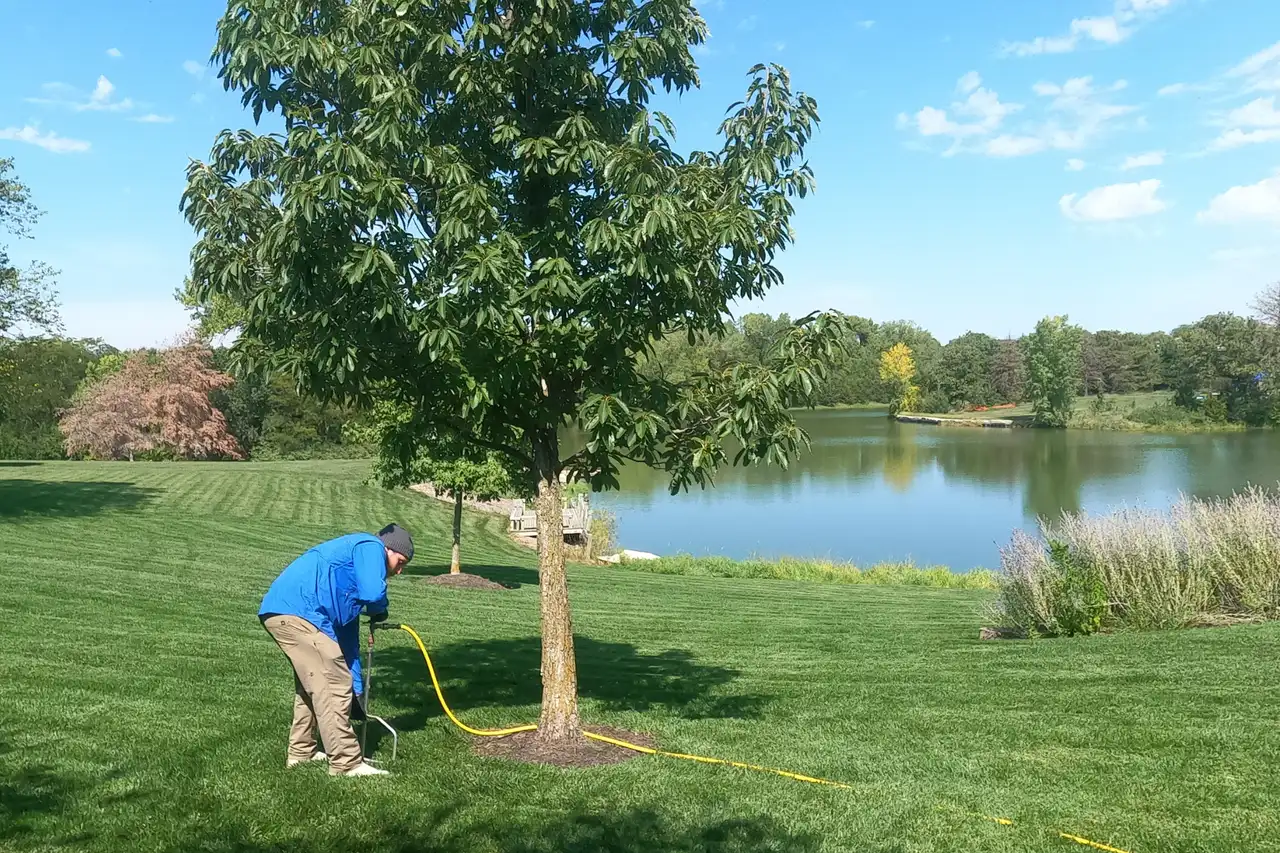
On an established tree, trunk injection is the approach with the most reliable results.
Iron is introduced directly into the tree's vascular system, bypassing the soil chemistry problem entirely. The tree distributes it internally, and the response is usually visible within weeks, with foliage greening noticeably.
It is done by a licensed applicator, and it is repeated periodically rather than being a permanent cure. Depending on severity and the tree, that may be every year or every couple of years. The underlying soil pH does not change, so the condition returns if treatment stops.
For smaller trees and shrubs, chelated iron applied to the soil or as a foliar spray can be sufficient and is less invasive. Foliar application greens up existing leaves quickly but does not reach new growth, so it is a shorter term measure.
Timing matters. Treatment while the tree is actively growing and moving fluid works better than treating a stressed or dormant tree, which is one reason autumn is the right season to plan rather than to inject.
The Things That Make It Worse
Several conditions push a marginal tree into visible chlorosis, and some are within your control.
Compacted soil restricts root function and reduces uptake of everything, iron included. Poor drainage does the same, and saturated soil around roots is a common contributor on heavy Nebraska ground.
Overwatering is an underrated cause. Roots sitting in consistently wet soil take up nutrients poorly, and a tree in the middle of an irrigated lawn is frequently getting more water than it wants.
And planting too deep, which is extremely common, weakens a tree in ways that show up as general decline including worse chlorosis. The root flare should be visible at the soil surface, not buried.
Addressing compaction and drainage will not change soil pH, but it improves what the tree can do with the iron it can reach.
Your Lawn Can Show It Too
Trees get most of the attention on this, and turf on the same alkaline soil runs into the same chemistry.
On a lawn it presents as a general pale yellow-green cast that does not respond to nitrogen the way it should. Homeowners apply more fertilizer, get a slight temporary improvement from the nitrogen, and the underlying color never really arrives.
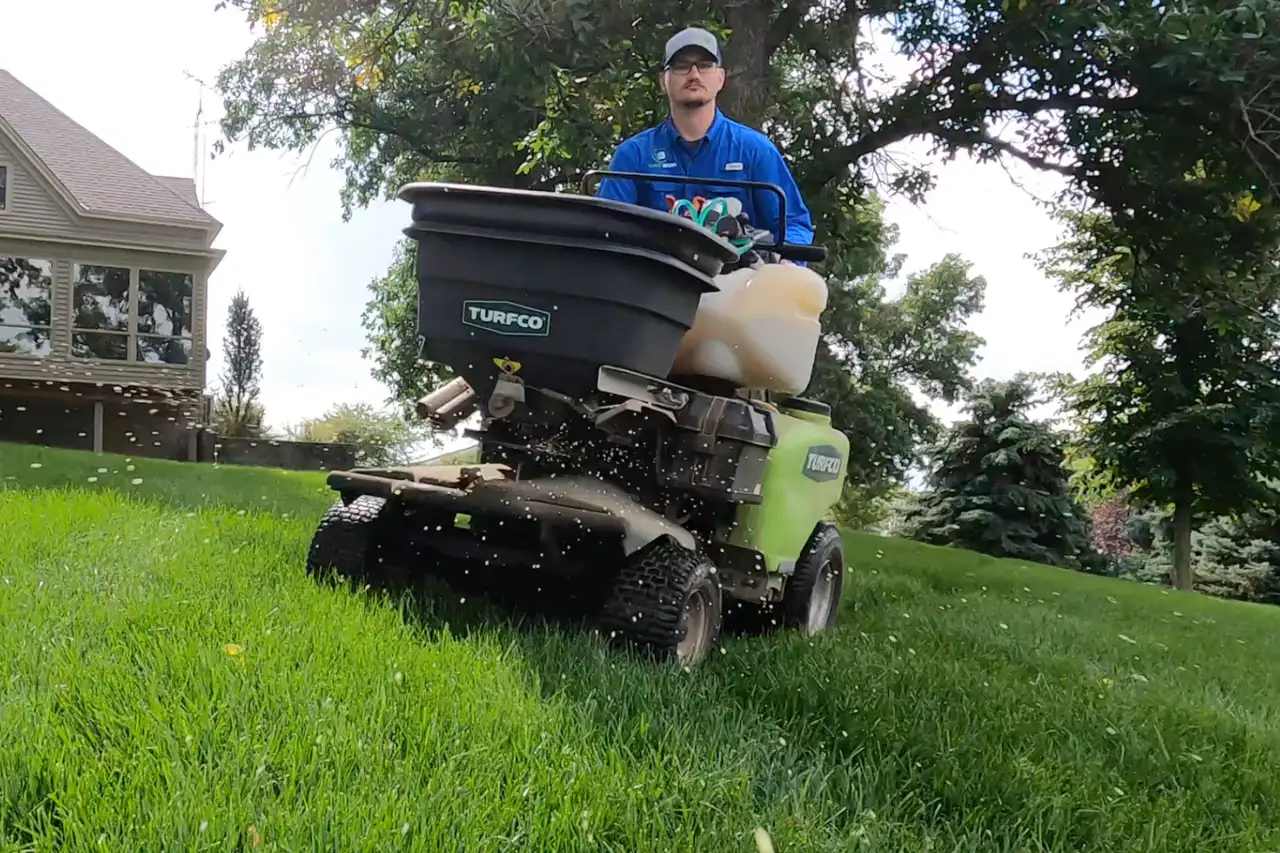
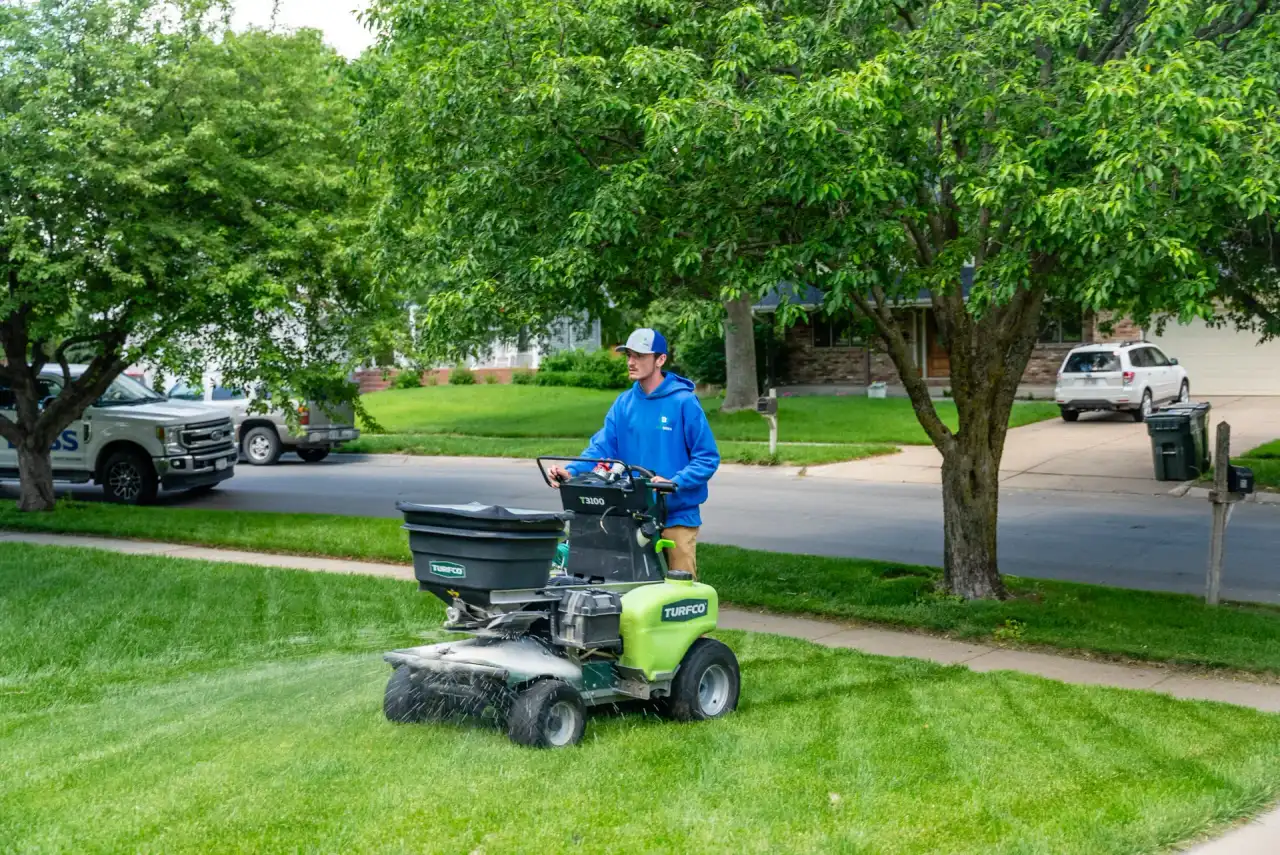
Applying iron to turf produces a noticeable deep green response, and it does so without the flush of growth that nitrogen drives, which is genuinely useful late in the season when you want color rather than top growth. It is also why micronutrient applications are part of a properly built Nebraska lawn program rather than an upsell.
The caution is that iron products stain. Concrete, pavers, and stonework will discolour where granules land or spray drifts, and those stains are stubborn. Whoever applies it should be blowing hard surfaces off carefully afterward.
What to Do Next
Go look at your trees while the leaves are still on, which is the only time this is diagnosable. Check whether yellowing leaves have green veins, and check whether the worst of it is at the top and on new growth.
If you find that pattern, resist the urge to fertilize. It is the intuitive response and it is the wrong one.
If a tree has struggled for several years and is a species poorly suited to our soil, it is worth an honest conversation about whether ongoing treatment or eventual replacement makes more sense.
If you would like an assessment, Yard Boss has provided tree and plant care alongside lawn treatment across Lincoln, Omaha, and the surrounding communities for eighteen years. Call 402-418-2233 or visit yardbosslawns.com.
Here is what to expect. We will confirm the pattern is genuinely chlorosis rather than something else, tell you plainly that treatment manages the condition rather than curing it, and be honest if a tree is a species that will fight our soil for its whole life. On a replacement, we will point you toward something that does not need treating at all.